
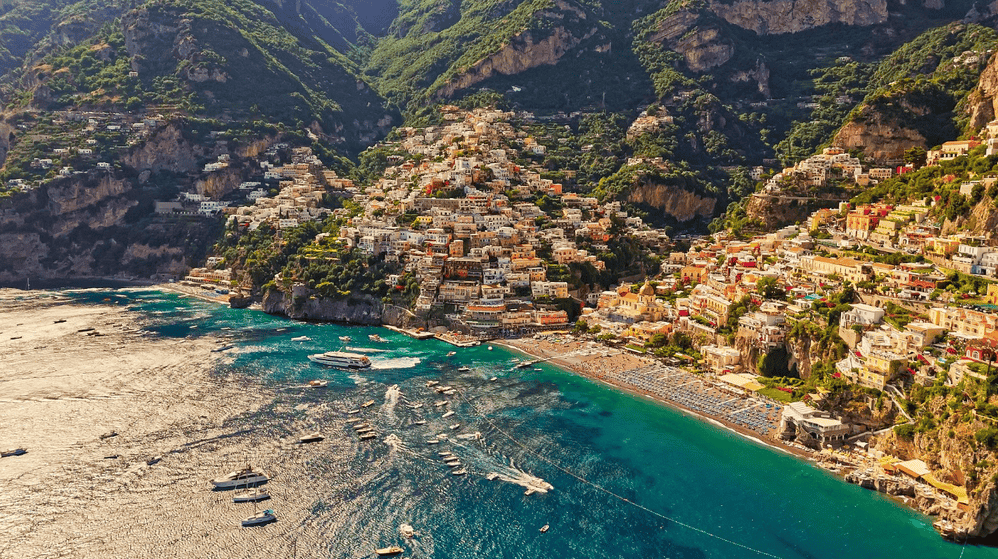
The Amalfi Coast looks compact on a map. Positano, Praiano, Amalfi, Ravello, and the smaller towns appear close enough to fit into a few efficient days. In practice, distance is only part of the calculation. The coast is vertical, the road is slow when traffic builds, ferry schedules shape some journeys, and every change of hotel creates a second trip around the trip itself.
That is why the useful question is not simply how many nights to book. It is how many usable days you want on the coast, and how much of those days you are willing to spend moving.
The short answer: 3, 5, or 7 days?
For most first-time visitors, five full days is the strongest balance. Three days can work very well if the Amalfi Coast is one part of a longer Italy trip and you accept that some places will stay off the itinerary. Seven days makes sense when the coast is one of the main destinations of the vacation and you want time for the sea, the towns, and at least one day that is not built around a checklist.
The important word is full. A three-night stay that begins with a late-afternoon arrival and ends with an early departure does not give you three days on the Amalfi Coast. It may give you two.
Before deciding whether you need three, five, or seven days, look at your itinerary from morning to evening rather than from hotel check-in to hotel check-out.
First, count usable days instead of hotel nights
Travel itineraries often hide their most important detail in the wording. Four nights sounds generous. Then the first night begins after a flight, train, and transfer from Naples, while the final morning disappears into the journey to the next destination.
This matters more on the Amalfi Coast because arrival itself can require several stages. Depending on where you are staying, reaching the hotel may involve a car, ferry, bus, porter, stairs, or a walk through a pedestrian area after the main transfer has technically ended.
The same applies when you move from one base to another. A transfer that looks short on a timetable can occupy the middle of the day once checkout, luggage, waiting, boarding, arrival, and check-in are included.
A useful way to plan is therefore to separate travel days from Amalfi Coast days. Arrival and departure days still have value, but do not ask them to do the work of a full day.
What three days on the Amalfi Coast actually gives you
Three full days is enough for a good first experience, but not for a complete one. The trip works when you accept that from the beginning.
A realistic three-day stay usually needs one base and three clear priorities. One day might focus on Positano and the western side of the coast. Another can give Amalfi and Ravello the time they deserve. The third can become a day on the water, when the coastline itself becomes the destination rather than the road between towns.
What fits in three days
You can see the two names most first-time visitors come for, Positano and Amalfi, while still leaving time for Ravello or another nearby stop. You can also dedicate a full day to the sea, which gives you a different understanding of the geography and allows several stretches of coast to be experienced without treating every town as a separate transfer.
If a boat day is part of the trip, the Amalfi Coast and Positano itinerary shows how a full coastal day can connect navigation, swimming, and time ashore without turning each movement into dead time.
What probably stays out
The difficult part of a three-day trip is everything else that looks close enough to add.
Capri requires meaningful time of its own. Pompeii changes the trip from an Amalfi Coast stay into a wider Campania itinerary. A long hike needs a morning or afternoon that is not already carrying two towns. The smaller villages become worthwhile only when you are not watching the clock.
You can add one of these things. Trying to add all of them usually means that the trip becomes a sequence of departures rather than a stay on the coast.
Why five days is the sweet spot for most first-time visitors
Five full days changes the trip because the itinerary no longer needs every day to perform at maximum efficiency.
There is enough room for Positano and the western coast, Amalfi and Ravello, and a full day at sea, while still keeping one or two days flexible. That flexibility is what three-day itineraries usually lack.
You might use it for a hike, a slower beach day, one of the smaller towns, or a day trip beyond the coast. You might also use it for nothing ambitious at all, which is often when the trip starts to feel like a vacation rather than a project.
Five days also gives you more freedom around weather. If a private boat is important to the trip, you do not have to force it into the only available date. You can place it where conditions make the most sense and shift a land day if necessary.
For travelers who have not yet chosen the season, our month-by-month guide to the Amalfi Coast looks at how weather, sea temperature, crowds, and boat conditions change through the year.
What fits in five days
Five days gives the major places enough separation that they stop competing with one another. You can spend real time in Positano without worrying that Amalfi must happen before lunch. Ravello can be more than a quick viewpoint. A boat day can remain a boat day instead of becoming a transport solution squeezed between two hotel reservations.
It also becomes realistic to include one major experience outside the core coast, such as Capri, without sacrificing most of the Amalfi Coast itself.
What you still do not need to do
Five days is not an invitation to change hotels three times.
The temptation is understandable. Staying in several famous towns can look like a more complete experience on paper. In reality, each move has a logistical cost, and the coast is connected well enough in season that many places are better treated as day trips rather than new bases.
What seven days changes
Seven full days is not simply the five-day trip with two more attractions added. Its real advantage is that you can stop optimizing every hour.
You can spend a morning somewhere without already knowing what the afternoon must contain. You can return to a place you liked instead of immediately moving on. You can give a boat day the best weather window rather than the only open square in the calendar.
A week also makes one substantial excursion much easier to absorb. Capri can take a full day without consuming a third of the trip. A hike can have its own morning. A quiet beach or smaller village no longer has to justify itself against Positano or Ravello.
For travelers who want the Amalfi Coast to feel like the destination rather than one stop in a fast Italian itinerary, seven days is not excessive. It simply changes the pace.
What fits in seven days
You can comfortably divide the trip between coastal towns, time on the water, one larger excursion, and at least one slower day. If you want to use two bases, a week is also where that decision begins to make more sense because each half of the stay is long enough to settle into.
What seven days should not become
A seven-day stay does not require seven different destinations. Adding a new place every morning removes much of the advantage that the extra time created.
The strongest week-long itineraries tend to contain more empty space, not more pins on the map.
Three, five, and seven days compared
| Time | Best for | What fits comfortably | Main sacrifice | Suggested bases |
|---|---|---|---|---|
| 3 days | A wider Italy trip | Positano, Amalfi/Ravello, one focused coastal or boat day | Smaller towns and major outside excursions | 1 |
| 5 days | Most first-time visitors | Main towns, boat day, slower day, optional major excursion | Very little if priorities are clear | Usually 1 |
| 7 days | The coast as a main destination | Main towns, sea, hike or beach time, one excursion, flexible days | Nothing essential | 1 or 2 |
The hidden cost of moving around the Amalfi Coast
The number most travelers underestimate is not the distance between towns. It is the time around the distance.
A forty-minute journey is rarely a forty-minute event.
You leave the hotel, deal with luggage if you are changing base, reach the road or port, wait for the service you are using, make the journey, arrive, and then still have to reach the next accommodation. In a vertical town, the final few hundred yards may involve stairs, a porter, or another local transfer.
None of this makes the Amalfi Coast difficult to visit. It simply means that moving should be treated as part of the itinerary rather than as blank space between the things you actually want to do.
This becomes especially important when you change hotels. Our guide to traveling with luggage between Naples, the islands, and the coast looks at the practical side in more detail, including why the stretch between the dock and the hotel often matters as much as the main journey.
The hidden cost is therefore not only financial. It is time, energy, and the loss of flexibility. On a three-day trip it can reshape the whole stay. Even on a seven-day trip, unnecessary hotel changes can turn the extra time you paid for into time spent checking in and out.
One base or two?
For three days, use one base.
For five days, one base is still the simplest choice for most travelers. You can reach different parts of the coast during the day without packing again every forty-eight hours.
For seven days, one or two bases can both work. Two make sense when they create a genuinely different second half of the trip, not simply because two famous hotel names looked appealing during planning.
This article deliberately does not choose between Naples, Sorrento, Positano, and the other possible bases. That decision depends on what else is in the trip, whether Capri is included, and how often you expect to travel by sea. For one example of the one-base approach, our guide to using Sorrento as a base for Capri, Nerano, and the coast explains why some travelers prefer to unpack once and travel outward each day.
Sorrento is outside the Amalfi Coast itself, but its position makes it part of the practical planning conversation for many visitors arriving from Naples or combining the coast with Capri.
Where a boat day changes the calculation
A boat day does not create more hours. It changes what the hours are doing.
On land, the movement between two towns is usually something you complete in order to reach the next experience. On the water, movement and sightseeing can happen at the same time. Positano appears gradually from offshore. Praiano, Conca dei Marini, and the cliffs between the larger towns are part of the journey rather than places hidden between departures and arrivals.
That is the planning advantage of seeing the Amalfi Coast by private boat. Navigation is not simply transportation. The coastline itself is what you are spending the day seeing.
A private day also allows the rhythm to change according to conditions. A swim can last longer, a crowded stop can become a shorter one, and time ashore can be adjusted rather than fixed to a public timetable. This is particularly useful on shorter stays, where one day needs to show you the geography of the coast without asking you to make several separate transfers.
Our longer guide to seeing the Amalfi Coast by boat compares that approach with the road, ferries, and other ways of moving along the coast.
So, how many days should you book?
There is no perfect number for every trip. The better question is what you want your days to feel like.
If your goal is to collect as many names as possible, three days can hold an impressive list. If you want to understand the coastline, spend time in the towns, have a full day at sea, and still leave some decisions for the morning itself, five days is a better starting point. If the Amalfi Coast is one of the reasons you are traveling to Italy in the first place, a week gives it room to become a place rather than an itinerary.
Planning an Amalfi Coast stay with a private day on the water?
Explore our Amalfi Coast and Positano private boat itinerary or request a personalized quote based on your dates, departure point, and the amount of time you have in the region.
Frequently asked questions
How many days do you really need on the Amalfi Coast?
For most first-time visitors, five full days is a strong balance. It gives you enough time for Positano, Amalfi and Ravello, a day on the water, and some flexibility without requiring every day to be packed. Three days works for a highlights trip, while seven days is better if the Amalfi Coast is one of the main destinations of your vacation.
Is three days enough for the Amalfi Coast?
Yes, if you keep one base and accept that you will not see everything. Three full days are enough for the principal towns and one focused coastal or boat day. Adding Capri, Pompeii, a major hike, and several smaller villages to the same three days will make the trip much more rushed.
Is five days too long on the Amalfi Coast?
No. Five days is long enough to separate the major experiences instead of combining several of them into each day. It also gives you more flexibility around weather and makes it possible to add one substantial day trip without losing most of your time on the coast.
Is seven days too much for the Amalfi Coast?
Not if the coast is a main destination of your trip. A week gives you room for the main towns, a boat day, a hike or beach day, one larger excursion, and slower time without changing destination every morning. The key is not to fill the extra days simply because they are available.
Should I stay in one town or change hotels?
For a three-day stay, one base is the clearest choice. For five days, one base still works well for most travelers. With seven days, one or two bases can both make sense, but a second base should create a meaningful change in the trip rather than add another transfer for its own sake.
Should Capri be included in an Amalfi Coast itinerary?
Capri can be included, but it is a separate island and deserves meaningful time of its own. On a three-day Amalfi Coast stay, giving one full day to Capri is a major trade-off. With five or seven days, it is much easier to include the island without reducing the coast itself to a short highlights tour.