The Amalfi Coast looks easy on a map. Thirty miles of coastline, a handful of famous towns, one scenic road that connects them. In practice, planning the way you move along it is one of the hardest parts of any Italian honeymoon or anniversary trip, and one of the few decisions that genuinely shape how the days will feel.
Most American travelers arrive expecting the road to do the work. It rarely does. The single coastal highway that runs from Sorrento to Salerno is often jammed in summer, the buses are crowded, parking is virtually nonexistent in Positano and Amalfi, and the drive that looks romantic from a film still becomes an exercise in patience when shared with tour coaches and rental cars.
There is another way to see the coast, the way it was meant to be seen. From the water.
This guide is written for couples planning a meaningful trip from the United States, who want to understand why so many seasoned travelers eventually trade the road for the sea, and how to design a private boat day that feels less like a tour and more like a quiet, well-paced afternoon along one of the most beautiful coastlines in the world.
Why the road is the wrong starting point
The Amalfi Coast’s charm is also its logistical problem. The SS163, the only road that links the towns, is narrow, winding, and shared between local traffic, tour coaches, scooters, and rental cars unfamiliar with the terrain. From June through September, that mix produces traffic jams that can stretch a thirty-minute drive into two hours. Parking in Positano and Amalfi often requires advance arrangements with hotels or paid lots set well above the towns, with stairs or shuttle buses in between.
Public transport works, but on its own terms. The SITA buses are reliable and inexpensive, but they get crowded, and the views, when traffic permits them, come from a window seat shared with strangers. Ferries are pleasant and scenic, but they follow fixed routes and schedules, and they stop running for the season in late October.
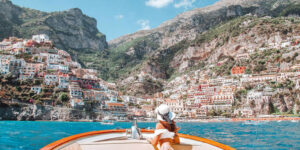
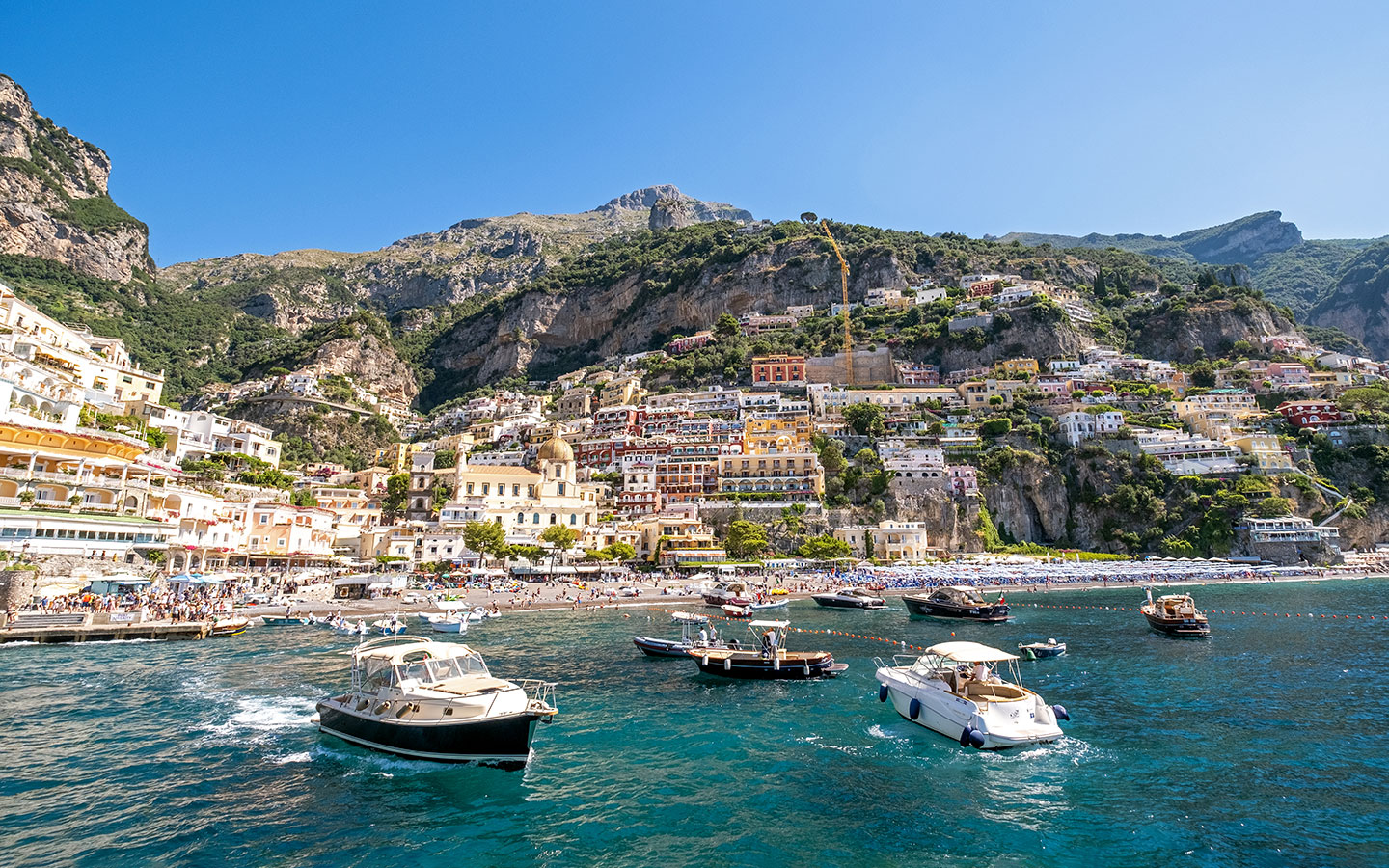
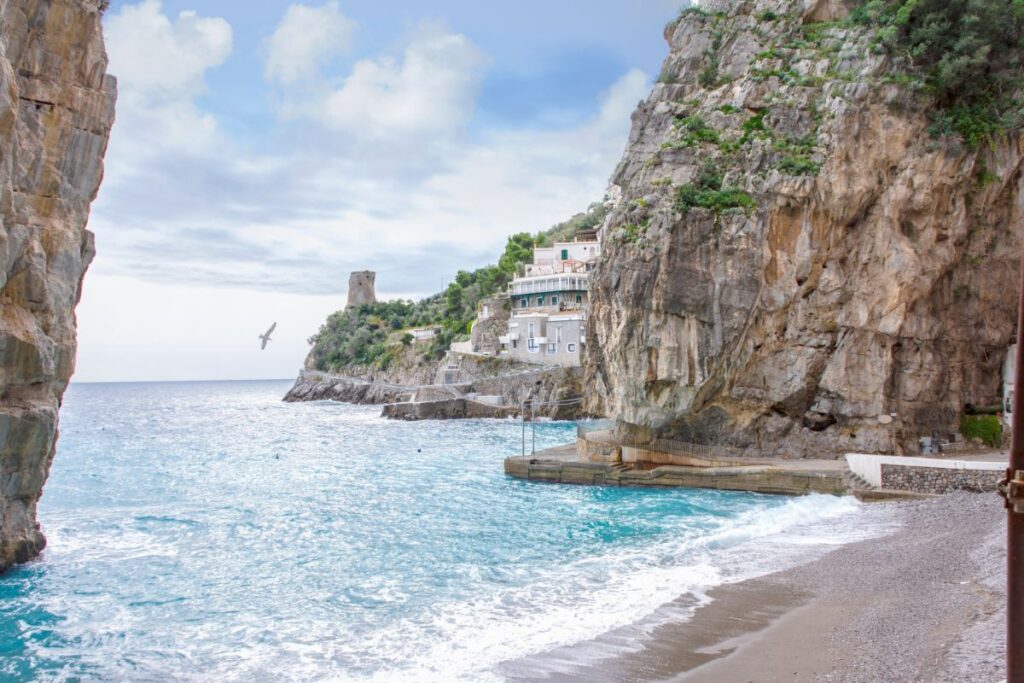
For a couple traveling once in a lifetime, or marking an anniversary, the friction of all this is worth understanding before booking. The most beautiful images of the Amalfi Coast, the layered houses of Positano rising from the water, the cliffs of Praiano at golden hour, the bay of Amalfi viewed from the sea, are almost always shot from a boat. There is a reason for that.
What “by boat” actually means: ferry, group tour, or private charter
Saying you want to see the Amalfi Coast by boat covers three very different experiences, and the difference matters.
Public ferries are the simplest option. They run between the main towns from roughly April to October, with one-way tickets in the range of fifteen to thirty euros depending on the route. They are a real upgrade from the bus and a wonderful way to arrive somewhere, but they are also a means of transport, not an experience. You sit on a deck with other passengers, follow a schedule, and disembark at a port.
Group boat tours sit in the middle. They depart from Sorrento, Positano, or Amalfi, usually carry between fifteen and forty people, and follow a fixed route with set stops for swimming. Prices range from roughly seventy to a hundred and twenty euros per person. They are convenient, and on a good day, they are pleasant, but the rhythm is collective. The boat stops where the schedule says it stops, the swimming time is allotted, and the soundtrack is shared.
Private charters are a different thing. You and your partner, sometimes with another couple, have the boat to yourselves and a local skipper at the wheel. The route is built around what you want to see and how long you want to linger. You decide whether to swim in a hidden cove for forty minutes or for two hours. You decide whether the day ends at sunset off Capri or with an aperitif aboard near Praiano. The cost is higher, generally between six hundred and twelve hundred euros for a full day depending on the boat and the season, but for a couple splitting a single fee rather than paying per person, the comparison with two seats on a group tour narrows considerably.
For a couple in their forties or fifties on a milestone trip, the private option is the one that consistently delivers what the photographs promise: silence, space, and time.
The case for a gozzo: why the boat itself shapes the day
Boats along this coast are not interchangeable. The boat you choose changes what the day feels like, its pace, its sound, its level of intimacy.
The traditional choice along the Sorrentine peninsula and the Amalfi Coast is the gozzo, a wooden Mediterranean fishing boat with a low profile, a wide stern, and a flat sun deck. Gozzi were built for these waters; they handle them gracefully, and they sit close enough to the surface that the line between sea and deck almost disappears. They are also quiet, which matters more than people expect. Faster modern boats deliver thrills, but they also deliver engine noise, vibration, and a sense of being in a vehicle. A gozzo cruising along Praiano at six knots feels closer to a slow walk than to a transfer.
For couples, the gozzo offers something else: scale. Designed for groups of six to ten, a gozzo chartered as a couple feels generous rather than empty. There is room to move, to sit forward at the bow, to lie back on the cushions on the stern, to share a meal at the small table in the shaded area. None of this is ceremony. It is simply how the boat is shaped.
Designing a day on the water as a couple
The most common mistake we see among first-time visitors is treating a boat day like a sightseeing checklist: Capri, Positano, Amalfi, all in one afternoon. It is technically possible. It is also the wrong frame.
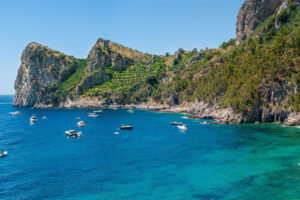
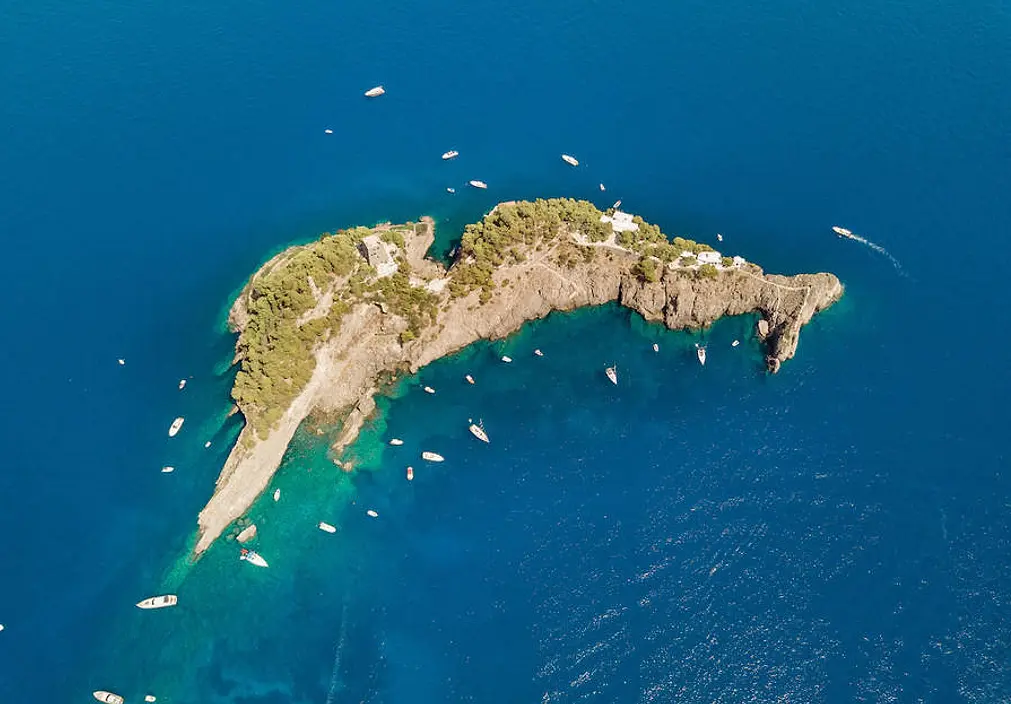
A well-designed private day along the Amalfi Coast is built around two or three anchors, with deliberate emptiness between them. An anchor might be a swim at the Li Galli islands, lunch at a seaside restaurant in Nerano, an hour spent floating off the cliffs of Praiano with a glass of cold Falanghina, or watching the light change over Positano from the water just before sunset. A well-paced private boat tour along Amalfi and Positano looks very different from a route that pushes Nerano and the Li Galli into the same afternoon, and the choice depends entirely on what you want the day to feel like.
The slowness is the point. From land, the Amalfi Coast is a sequence of arrivals: you walk into a town, you eat, you photograph, you leave. From a boat, it becomes a continuous landscape that changes with the angle of the sun. The towns are no longer destinations; they are passages, seen from the perspective they were built to be seen from, by the people who lived here long before the road existed.
For couples celebrating an anniversary, the rhythm to aim for is roughly six to seven hours on the water, including a long, unhurried lunch break either at a coastal restaurant or aboard. That is enough to cover three to four notable stretches of coastline without rushing, and to leave you with the rare feeling, at the end of the day, of having had time.
When to come: matching the season to what you want from the trip
Americans planning their first Amalfi trip often default to July or August, partly because school calendars and corporate vacation cycles push them there. For couples without that constraint, this is the single most consequential decision after choosing the boat itself.
Late May and June offer the best balance for most couples. The water is warm enough for comfortable swimming by mid-May, the days are long, the bougainvillea is in full bloom, and the towns have not yet hit peak crowding. Sea conditions are typically calm, which matters when you are spending a full day on the water.
July and August deliver the iconic Amalfi Coast, vibrant, sun-drenched, alive, but they also bring heat that can climb above 90°F, crowded restaurants, and traffic that turns the road into a constraint. On the water, the difference is less dramatic than on land, which is one of the underrated arguments for a boat day in high season: the sea is cooler, less crowded, and the breeze creates its own microclimate. If your trip falls in these months, plan land activities for early morning and evening, and reserve the middle of the day for the boat.
September and early October are, for many couples, the sweet spot. The summer crowds thin, the light shifts to a warmer angle that photographers prize, the water is at its warmest from the long summer, and the towns recover something of their off-season pace. Boat conditions remain reliable into mid-October, after which the season effectively ends.
Late October through April is a different coast entirely. Many restaurants and hotels close, ferries scale back, and weather becomes unpredictable. It is not the right window for the kind of trip we are describing.
Where to base: choosing a town with the boat in mind
Most US guides recommend Positano or Amalfi as the base for a coast trip, and for many travelers they are the right choice. But if you are building your stay around water-based experiences, the calculation shifts slightly.
Positano has the best access to the most photographed coastline and is the easiest base for boat departures toward Capri, Li Galli, and Nerano. It is also the most expensive and the most crowded.
Sorrento sits just outside the Amalfi Coast technically, but it is the most practical base for couples who want to combine boat days with day trips to Capri, Pompeii, and Naples. Transfers to Positano and Amalfi by sea are quick and far more pleasant than the road. Hotels offer better value than Positano for comparable comfort, and a Capri and Sorrento itinerary works particularly well from this base.
Amalfi itself is a good middle option, particularly if you want to spend more time exploring towns farther east, like Ravello, Atrani, and Minori.
Praiano is the quietest of the named towns and one we often recommend to couples who prioritize peace over proximity to nightlife. It has fewer restaurants and shops than Positano, but a calmer atmosphere and excellent boat access.
A two-base strategy, three nights in Sorrento and three nights on the coast itself, works particularly well for couples who want both an easy arrival from Naples and a deeper immersion in the Amalfi towns.
What to budget, honestly
For a couple planning a five-to-seven-day Amalfi trip from the US, here are realistic ranges.
A full-day private boat charter on a traditional gozzo, including skipper, fuel, and basic refreshments aboard, typically costs between eight hundred and twelve hundred euros. This is the price for the boat as a whole, not per person, meaning two travelers carry the full cost between them. Additional couples sharing the boat divide that figure.
Lunch at a seaside restaurant in Nerano or Praiano runs roughly fifty to ninety euros per person, including wine. A premium hotel on the coast in shoulder season ranges from three hundred to seven hundred euros per night, depending on the town and the property. Private transfers from Naples airport to the coast are typically between one hundred fifty and two hundred fifty euros.
Across a full week, a couple traveling at the level we are describing should plan for a total trip cost, flights aside, in the range of five thousand to nine thousand US dollars. The boat day, in this context, is not the most expensive line item; it is the one most likely to become the day they remember most clearly years later.
Practical advice from American couples we have hosted
A few patterns recur in conversations with US guests after their trip.
The first is timing. Most regret not booking the boat earlier in the trip rather than later. Couples who put it on day five spend the first four days hearing about it from other travelers and arriving at it slightly road-weary. Couples who plan it for day two arrive on the boat fresh, and use the rest of the trip to revisit the towns they glimpsed from the water.
The second is the matter of expectations versus pace. American travelers often arrive with a list of must-see locations, and the temptation to compress them into a single day is strong. The couples who are happiest at the end of their boat day are the ones who, on the morning of, agree to drop one stop from the original plan.
The third is communication with the skipper. The best private boat experiences along this coast happen when guests treat the skipper as a local guide, not as a driver. Asking where he would go for lunch on a Tuesday in June, or which cove is least crowded at noon, almost always produces a better day than following a pre-set route.
Planning the trip from where you are
For travelers based in the United States, the practical sequence is straightforward. Direct flights to Naples Capodichino are now available from several US gateways during the summer season; alternatively, a connection through Rome, Milan, or a major European hub is reliable year-round. From the airport, the most comfortable transfer to the Amalfi Coast is a private car or boat transfer, taking roughly ninety minutes to Sorrento and two hours to Positano. The high-speed train from Rome Termini to Naples runs hourly and pairs well with onward sea or road transport.
Most boat charters book up four to eight weeks in advance for the high season, and longer for the most-requested dates around late June, July weekends, and the first half of September. Couples planning a milestone trip, an anniversary, a honeymoon, a birthday, should treat the boat reservation with the same priority as the hotel.
A different way to remember the Amalfi Coast
What stays with travelers, in our experience, is rarely the photograph at the most famous viewpoint. It is something quieter: a moment of silence drifting at anchor near the cliffs, a glass of cold wine at the bow as the wind picks up in the afternoon, a sunset that lasted longer because nobody was rushing to get back.
The Amalfi Coast rewards travelers who slow it down. A private boat is the most direct way to do that, not because it is glamorous, but because it returns the coast to the pace at which it makes sense.
If you are planning a trip from the United States and want to think through what a boat day could look like as part of a larger itinerary, we are always happy to talk through options before any booking commitment. Request a tailored quote and we will help you design the right boat day around your couple, your week, and the version of this coast you most want to come home with.
Useful resources for planning your trip
For travelers who want to verify schedules, transfers, and arrival logistics directly with local sources, a few official references are worth bookmarking. The Naples International Airport publishes up-to-date arrival information and ground transport options. The Travelmar and NLG (Navigazione Libera del Golfo) websites cover the main ferry routes between Naples, Sorrento, Capri, Positano, and Amalfi during the season. For coastal road transport, SITA Sud operates the bus network that connects the Amalfi Coast towns.