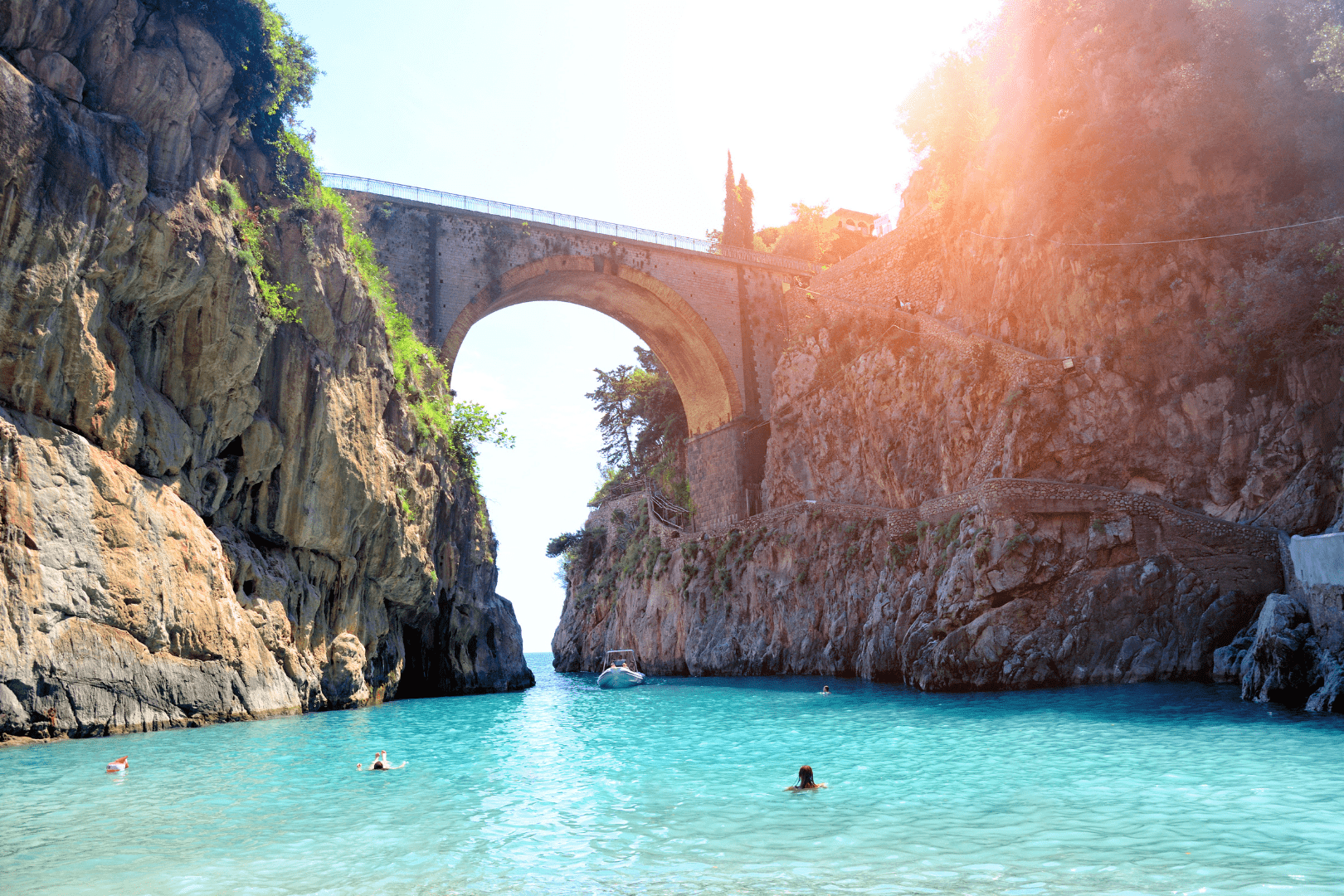
Between Positano and Amalfi, where the mountains fall straight into the sea, a narrow cleft splits the cliffs and a single arched bridge leaps across it thirty meters above the water. This is the Fiordo di Furore, one of the most photographed places on the Amalfi Coast and one of the most misunderstood. Most people see it for a few seconds through a bus window on the coast road, a glimpse of blue far below, and drive on. Seen that way, it barely registers. Seen from the water, it is something else entirely.
The Fiordo rewards understanding before you go, because it is not the easy beach stop its fame might suggest. It has real constraints, a difficult approach, and a history far richer than its postcard image. This is what it actually is, and why the sea is the honest way to judge it.
It is not really a fjord
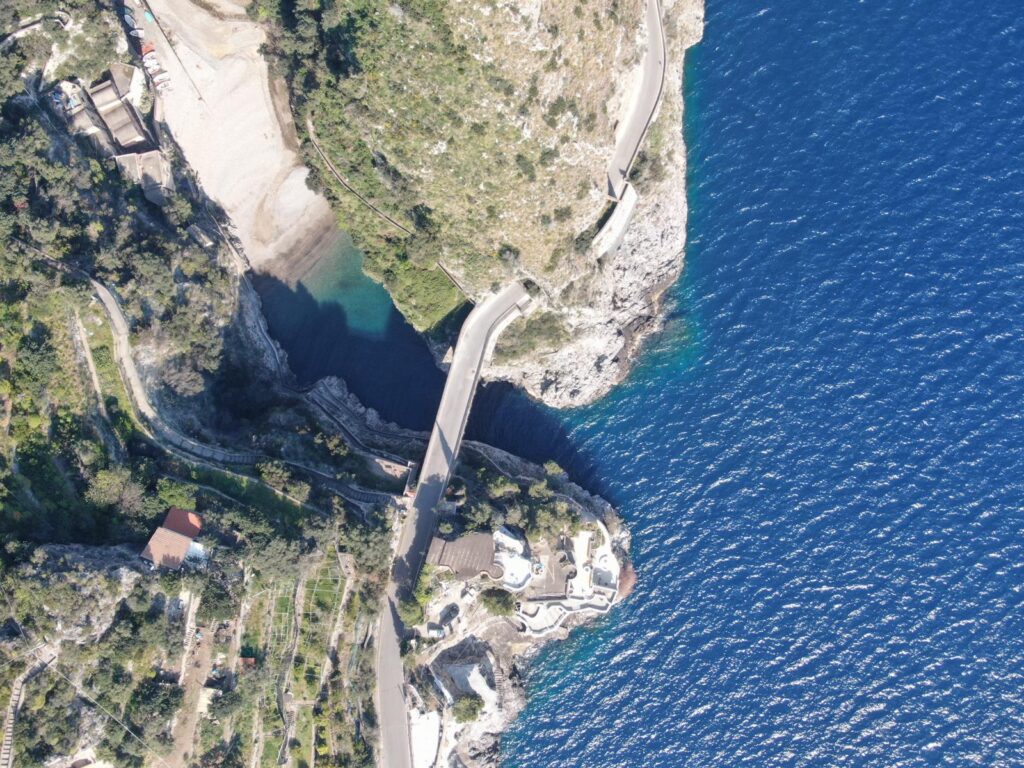
The name is romantic and geologically wrong. A true fjord is carved by glaciers, and no glacier ever reached this coast. What you are looking at is a ria, a narrow inlet cut over millennia by the Schiato torrent as it tumbles down from the Monti Lattari to the sea. The water has sliced a deep, steep-sided gorge into the rock, and the sea has flooded its mouth. The effect is fjord-like, hence the name, but the origin is a mountain stream, not ice.
At the bottom sits a tiny pebble beach, Marina di Furore, no more than twenty-five meters of shoreline, with a handful of old fishermen’s houses built into the rock. Above it arches the bridge that carries the coast road across the gorge. The whole scene is compressed into a slot in the cliffs, which is exactly what makes it so striking and so hard to appreciate from land.
Why the water is the honest vantage point
From the coast road, you are on top of the Fiordo, looking down into it. You see the bridge and a slice of the beach, but you cannot see the thing itself, the way the cleft opens in the cliff face and the sea pushes into it. That view exists only from the water. Approaching by boat, the gorge reveals itself as you draw near, the bridge framed against the sky, the houses clinging to the rock, the whole geological drama legible in a way it never is from above.
This is why the Fiordo belongs on a boat itinerary rather than a driving one. It was shaped by water and it is best read from water. The approach from the sea is the only vantage point that shows you what the place actually is, rather than a fragment of it glimpsed from a bridge you happen to be standing on.
The honest truth about access by boat
Here is where accuracy matters, because a lot of what is written about the Fiordo is optimistic. Boats cannot dock at the beach. Small craft may approach and anchor off the mouth of the gorge, near the bridge, but landing directly on the beach is generally not permitted for private boats, and the site has at times been closed altogether for rockfall risk and safety works. If you want to set foot on the sand, you do so by swimming in from the anchored boat, not by stepping off onto a jetty.
What a boat gives you, then, is the view and the approach, and the option to swim in the clear water at the mouth of the gorge, rather than a convenient beach landing. That is worth being clear about before you go, so the day matches your expectations. For many people the view from just offshore, with a swim in the deep water below the bridge, is the better experience anyway, and it sidesteps the crowds and the two hundred steps that the land approach involves.
What to know if you go by land instead
Reaching the Fiordo from the road is possible but awkward. The SITA bus on the Amalfi to Positano line stops right at the bridge, which is the least stressful option, because parking on the SS163 is almost nonexistent. From the road, a staircase of around two hundred steps descends to the beach. It is a real climb back up, and worth weighing if anyone in your group would find it difficult.
One quirk shapes any visit: light. Because the gorge is so deep and narrow, the sun reaches the beach only in the middle of the day, roughly late morning to early afternoon. Outside that window the Fiordo is in deep shade and noticeably cooler. If you are going for the turquoise water and the photographs, the timing is not optional, it is the whole thing. And the famous dives from the bridge are not for visitors: they are reserved for the athletes of the annual MarMeeting diving competition and forbidden to tourists for safety.
The love story written into the rock
The Fiordo’s fame is not only scenic. In April 1948 the director Roberto Rossellini came to this coast to shoot part of his film L’amore, with Anna Magnani in the lead and a young Federico Fellini among his collaborators. Furore was the couple’s retreat during the production, and Magnani bought one of the fishermen’s houses at Marina di Furore, the villa that today holds a small museum dedicated to her.
It was here, during those weeks, that the story turned. A letter arrived from the Swedish actress Ingrid Bergman expressing her wish to work with Rossellini, the spark of an affair that would end his relationship with Magnani. She is said never to have returned to Furore. The filming itself ranged across several villages on the coast, Maiori among them, so the Fiordo is more precisely the emotional heart of the story than the single set of the film. But the gorge and the little marina carry that history, and it gives the place a melancholy that the postcard version never hints at.
Seeing the Fiordo as part of a day on the water
The Fiordo works best not as a destination in itself but as one moment in a longer day along the coast. On a boat itinerary between Positano and Amalfi it sits naturally on the route, a place to slow down, take in the gorge from just offshore, and swim in the deep water below the bridge before continuing along the shoreline. Approached this way, it delivers what the bus-window glimpse never can.
Our Amalfi and Positano itinerary covers this stretch of coast, and our fuller guide to the Amalfi Coast by boat sets out how a day on the water fits together. Not far offshore lie the islands of Li Galli, another place that only makes sense from the sea, and our guide to planning a day by boat from Naples puts the distances in context. When you are ready to plan, the simplest step is to outline what you have in mind.
Frequently asked questions
Can you visit Fiordo di Furore by boat?
Yes, but with a limit worth knowing. Boats cannot dock at the beach. Small craft can approach and anchor off the mouth of the gorge near the bridge, and you reach the beach by swimming in. Landing directly is generally not permitted for private boats, and the site is occasionally closed for safety.
Is Fiordo di Furore actually a fjord?
No. A true fjord is carved by glaciers, and this coast never had any. The Fiordo di Furore is a ria, a narrow inlet cut by the Schiato torrent flowing down from the Monti Lattari to the sea. The effect resembles a fjord, but the origin is a mountain stream.
Can you swim at Fiordo di Furore?
Yes. There is a small pebble beach at the bottom, and the water is clear, though cooler than the open coast because sunlight reaches the gorge for only a few hours in the middle of the day. From a boat, you can swim in the deeper water at the mouth of the gorge.
Can you jump from the Fiordo di Furore bridge?
Not as a visitor. The dives from the thirty-meter bridge are part of the annual MarMeeting diving competition and are reserved for its athletes. Jumping is forbidden to tourists for safety reasons.
What is the best time of day to see it?
The middle of the day, roughly late morning to early afternoon. Because the gorge is so deep and narrow, sunlight reaches the beach and lights up the turquoise water only for a few hours. Before and after that window, the Fiordo is in deep shade.