Between Positano and Capri, three small islands sit just off the coast, close enough to see from the beach at Positano and impossible to set foot on. They are older than Rome, tied to one of the oldest stories in Western literature, and for much of the twentieth century they belonged to two of the greatest dancers who ever lived. This is the Li Galli archipelago, one of the few places on the Amalfi Coast that can only truly be understood from the water.
Where the Li Galli islands are, and what you are looking at
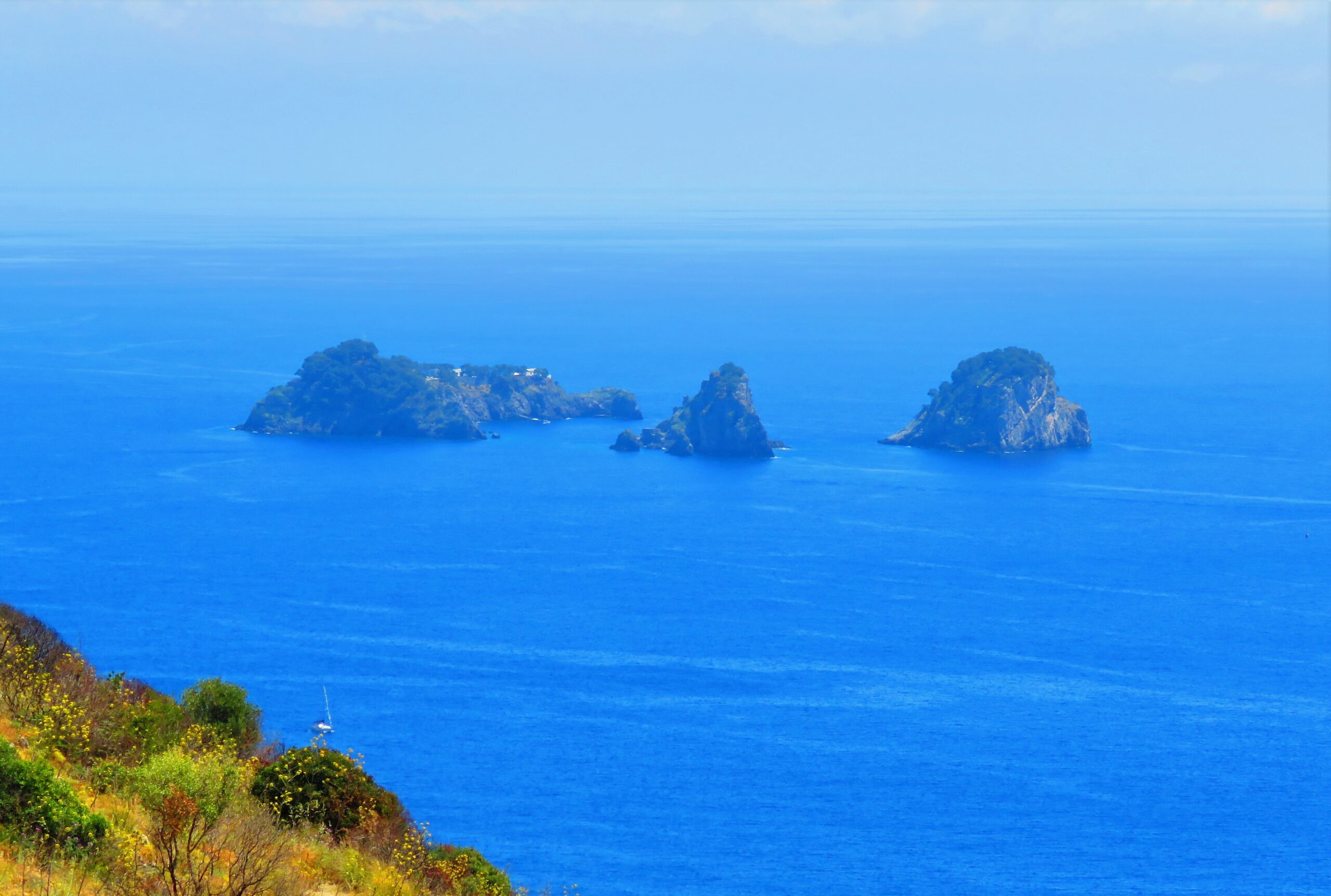
The Li Galli islands lie a few kilometers southwest of Positano, in the open water between the Amalfi Coast and the island of Capri. They sit at the tip of the Sorrentine Peninsula, and the sea around them belongs to the Punta Campanella Marine Protected Area, which keeps the water clear and the traffic light.
The archipelago is made up of three islets. Gallo Lungo is by far the largest, about four hundred meters long and, seen from above, shaped like a leaping dolphin. It is the only one that has ever been inhabited, and it carries the medieval watchtower and the villa that give the islands their human story. La Rotonda is a small, round outcrop, little more than a rock above the waterline. La Castelluccia, also known as the island of the brigands, takes its name from a time when it was used as a lookout, a place to watch the passage of merchant ships through the strait between the coast and Capri.
The sirens of Homer and the legend of Le Sirenuse
Long before they were called Li Galli, these rocks were known as Le Sirenuse, the islands of the sirens. The name is ancient. The Greek geographer Strabo placed the sirens here as early as the first century BC, and the association has never really let go.
In Homer’s Odyssey, Ulysses must sail past the sirens, whose song was said to lure sailors onto the rocks. Warned by the enchantress Circe, he had his crew fill their ears with wax and had himself tied to the mast, so that he could hear the song and survive it. Tradition gives the sirens of these waters three names, Parthenope, Leucosia, and Ligeia. The thread runs deep into the region: Parthenope is linked to the founding of Naples, and Leucosia gives her name to Punta Licosa further down the Cilento coast.
The myth has a plain explanation underneath it. The currents and winds in this stretch of sea were genuinely dangerous, and ships were lost here often enough that the wrecks needed a story. The sirens were that story.
Why the islands are called the roosters
The modern name is the detail most visitors find surprising. In ancient Greek art, the sirens were not the fish-tailed mermaids of later popular imagination. They were depicted as creatures that were half woman and half bird, with feathers and clawed feet. It is from that bird-like image that the islands took the name Li Galli, the roosters. The mermaid version came centuries later, with medieval tradition, and was simply layered over the older one.
There is a quiet irony in the name. The largest of the three islets, Gallo Lungo, named for a creature of the air, is shaped almost exactly like a dolphin when you see it from above.
A thousand years on Gallo Lungo
Gallo Lungo has been lived on since antiquity. The remains of a Roman residence are still on the island, evidence that the appeal of this isolated spot is nothing new. In the medieval centuries a defensive tower was raised here, part of the long chain of watchtowers that guarded this coast against raiders arriving by sea. The neighboring islet, La Castelluccia, served a related purpose, a vantage point over the busy passage between the mainland and Capri.
For most of its history, then, Li Galli was a place of watching and waiting, a small outpost on a strategic stretch of water. Its transformation into something else entirely came only in the twentieth century.
When the islands of the sirens belonged to two great dancers
In the 1920s the Russian choreographer Léonide Massine bought Gallo Lungo. He converted the old tower into a residence with a dance studio and an open-air theater, and built a villa on the Roman foundations, a project generally credited to the architect Le Corbusier. Under Massine the island became a private retreat for an artist at the height of his career, a place to work and to think away from the stages of Europe.
After Massine’s death in 1979 the islands changed hands, and in 1988 they were acquired by Rudolf Nureyev, perhaps the most celebrated male dancer of the century. Nureyev reshaped the villa in a Moorish style, with mosaics and tilework, and kept a mirrored studio where he continued to practice even as his health declined. He left the island for the last time in 1992 and died the following year. Since the 1990s the archipelago has remained privately owned and closed to the public.
Why Li Galli can only be experienced from the sea
Because the islands are private, no one walks their paths or stands on their terraces. The only way to truly see Li Galli is from the water, and this is exactly what makes them worth the detour. From a boat you can round Gallo Lungo slowly, watching the dolphin shape resolve, the tower appear above the rock, the villa terraces catch the light that once drew dancers here. The surrounding waters, protected and unusually clear, are a fine place to swim when the sea is calm.
On a private boat tour of the Amalfi Coast and Positano, a pass around Li Galli becomes one of the most atmospheric stops of the day, with the time to linger, swim, or simply drift while the story is told at your own pace rather than a timetable’s. Because the islands sit exactly between the two, they also fit naturally into an itinerary that links Capri and Positano. For travelers building a wider trip, our guide to the Amalfi Coast by boat sets the archipelago in the context of the whole coastline, and those drawn to where legend and geology meet will find a companion piece in the Faraglioni of Capri seen from the sea.
Good to know
Can you visit Li Galli? The islands are privately owned and cannot be visited on foot. They are admired from the water, on a boat passing close to the shore.
How far are they from Positano? A few kilometers to the southwest, roughly a fifteen to twenty minute crossing by private boat from Positano, depending on the sea.
Can you swim near the islands? Yes, in the surrounding protected waters, when conditions allow. The sea here is part of the Punta Campanella Marine Protected Area.
When is the best light? The softer light of the morning or late afternoon suits the islands best, and the sea is usually calmest earlier in the day.