Amalfi Coast by Boat: A Complete Guide to Positano, Amalfi, and the Towns Along the Coast
Why a private boat
Every experience on this page is fully private. The boat is reserved exclusively for your group, the schedule is yours, and the skipper adapts the day to the rhythm of the coast and your pace. No shared groups, no fixed commentary, no timetable imposed from outside.
This is the difference between passing along the Amalfi Coast and actually inhabiting it for a day.
FAQs
How long does a typical Amalfi Coast boat tour last?
A full day on the water runs eight hours or more, including lunch and swimming time. Half-day formats of three to four hours are also possible, particularly for travelers focused on a single stretch of coast or for sunset itineraries along Positano and Praiano.
Where do private boat tours of the Amalfi Coast depart from?
Departures are available from Naples, Sorrento, and Positano. Naples works best for guests staying in the city or arriving by cruise. Sorrento is the most efficient base for travelers combining the Amalfi Coast with Capri. Positano allows the fastest start for a day focused entirely on the Amalfi towns.
When does the Amalfi Coast boat season start and end?
The season runs from late April through late October. Outside this window, many operators reduce service, and weather conditions become unpredictable. Mid-season, from May to early October, offers the most reliable combination of calm sea and full town infrastructure.
What is the best time of year for a private boat tour of the Amalfi Coast?
May, June, and September are the best months. The sea is calm, the towns are not yet at peak crowding, and the light is at its softest. July and August offer the warmest water and the most vibrant atmosphere along the coast, with the boat day often being the most comfortable part of a high-season trip.
For all other questions about on-board services, booking, and policies, visit our FAQ page.
Exploring Amalfi Coast on land
The Amalfi Coast is best understood from the sea, but several of its richest experiences happen on foot, in the gardens of Ravello, on the Path of the Gods above Positano, in the cloisters of Amalfi, or among the lemon terraces of Minori.
For private guided tours of Amalfi, Pompeii, and the surrounding archaeological and cultural sites, visit Luca Tour Guide, the land-based complement to every sea experience.
Related Articles
reserved for your
group only
The Amalfi Coast: a coastline shaped by the sea
The Amalfi Coast occupies the southern face of the Sorrento Peninsula, a dramatic stretch of limestone cliffs that fall directly into the Tyrrhenian Sea. Geologically, it is a young and unstable landscape, shaped by tectonic uplift, marine erosion, and the slow descent of mountain torrents that have carved deep valleys between the towns. Almost every settlement here grew where a stream meets the sea, in the only flat ground available.
For most of its history, this coastline was easier to reach by boat than by land. The Republic of Amalfi, one of the four maritime republics of medieval Italy, built its wealth here in the ninth and tenth centuries, trading with Constantinople, Egypt, and North Africa long before any road connected the towns to Naples or Salerno. The single coastal road, the SS163, was completed only in 1853. Until then, the sea was the highway, and the towns were arranged around their harbors rather than around their squares.
This historical fact still shapes how the coast feels today. From the water, the towns appear as they were originally meant to be seen: layered against the cliff, their old quarters facing the sea, their churches and watchtowers acting as landmarks for arriving boats. From the road, much of this geography is invisible.
The entire Amalfi Coast has been recognized as a UNESCO World Heritage Site since 1997, listed for the integration between human settlement and natural landscape that defines the region.
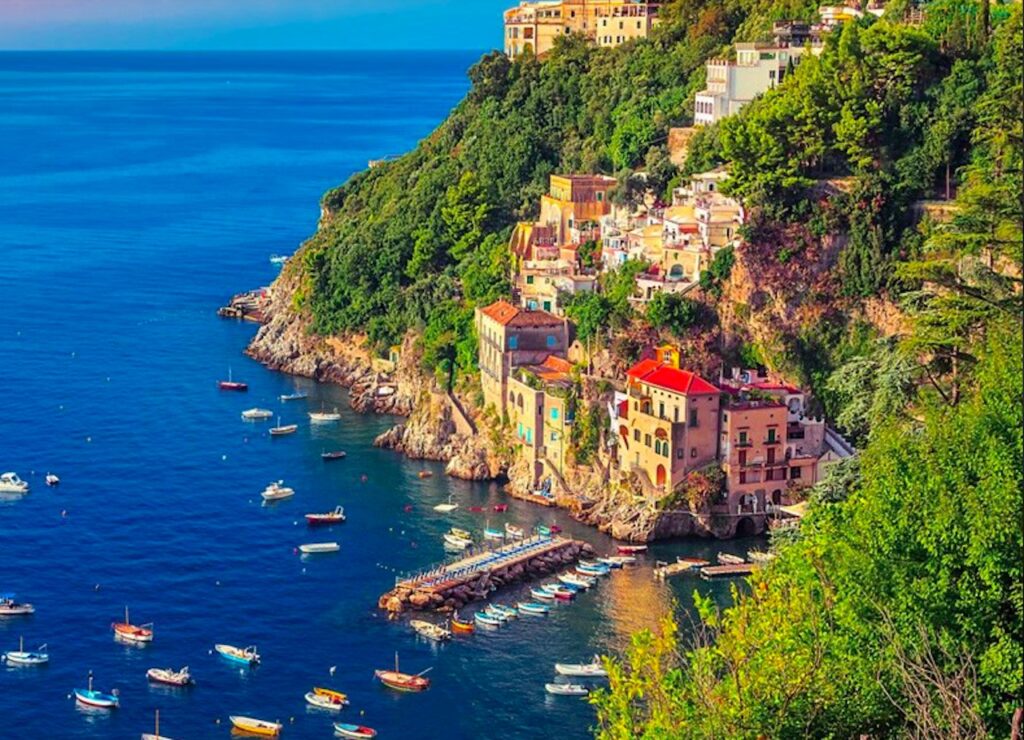
The towns of the Amalfi Coast, seen from the water
The towns of the Amalfi Coast are often discussed as a single destination, but they differ considerably in size, atmosphere, and what they offer to a traveler arriving by sea. The brief portraits below cover the main towns visible from a private boat tour, with notes on what each one looks like from the water and what makes it distinctive.
Positano
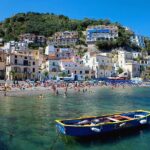
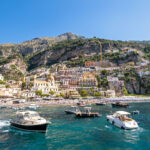
Positano is the most photographed town of the coast and the one most travelers picture when they imagine the Amalfi. Pastel-colored houses rise from the beach in vertical layers, crowned by the green-and-yellow majolica dome of Santa Maria Assunta. From the sea, Positano shows its full architectural drama: there is no flat ground here, and the town reads as a continuous facade that climbs three hundred meters above the waterline.
For boat tours, Positano is both a visual highlight and a practical anchorage. Tenders can land at Spiaggia Grande for lunch or shopping, and the smaller Fornillo beach to the west offers a quieter alternative. The waters off the Galli Islands, just southwest of Positano, are among the calmest and most photogenic on the coast.
Praiano
Praiano sits on the headland between Positano and Amalfi and is the quietest of the major towns on the coast. It has fewer hotels, almost no nightlife, and a slower pace than its neighbors. From the sea, the most striking feature is the long flight of steps descending from the village to the small Marina di Praia, a fjord-like inlet between two rock walls.
Praiano is a town we recommend frequently to couples and small groups who want a base for the Amalfi Coast without the crowds of Positano. From the water, it offers some of the cleanest swimming on the coast, particularly off the Cala della Gavitella, the only Amalfi beach that catches the sun until late afternoon.
Conca dei Marini and the Grotta dello Smeraldo
Just east of Praiano, Conca dei Marini is a small fishing village wrapped around a horseshoe bay, with one of the most distinctive coastal silhouettes on the Amalfi. The town is known internationally for the Grotta dello Smeraldo, the Emerald Cave, a sea cavern named for the green tone of its waters, illuminated through an underwater opening that filters the light from below. The cave can be entered by small boat or by elevator from the road above, and is best visited late in the morning when the light reaches its peak intensity.
Conca dei Marini is also the historical home of the sfogliatella Santa Rosa, a Neapolitan pastry first prepared in the eighteenth century by the nuns of the Santa Rosa monastery overlooking the bay.
Amalfi
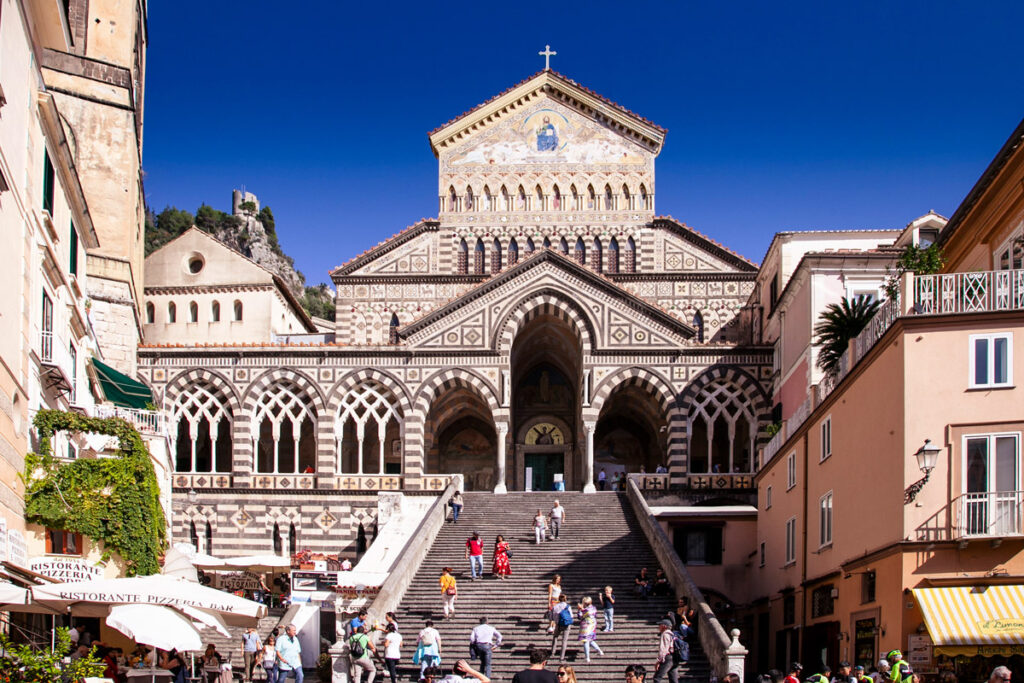
Amalfi is the historical and symbolic heart of the coast, the town that gave its name to the entire region. From the sea, the approach is dominated by the silhouette of the Cathedral of Sant’Andrea, with its striped Byzantine-style facade and steep flight of stairs rising from the main square. Behind the cathedral, the town climbs into the Valle delle Ferriere, a green ravine that once powered the paper mills for which Amalfi was famous in the Middle Ages.
The marina of Amalfi is the most active on the coast, with regular ferry connections and good docking access for private boats. It works well as a midday stop on a longer boat tour, with a more substantial lunch infrastructure than Positano and a different visual character: less colored, more architectural, more historically dense.
Atrani
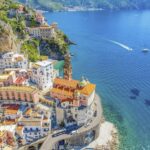
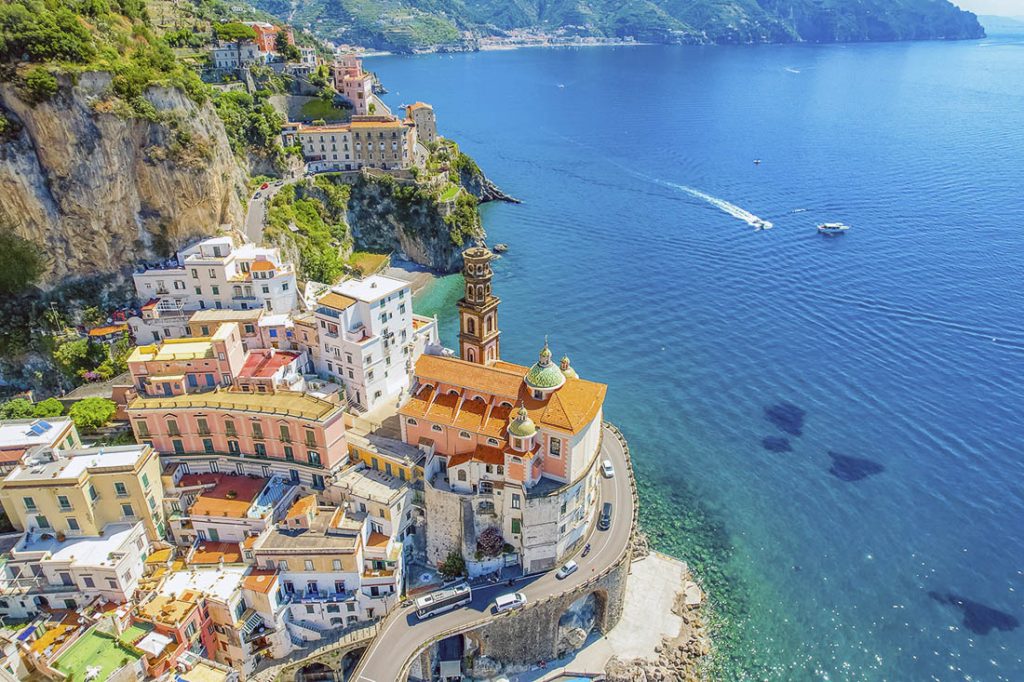
Adjacent to Amalfi but separated from it by a small rocky headland, Atrani is the smallest municipality in southern Italy by area. It feels almost hidden from the main coastal traffic, with a single piazza opening onto a small beach and the church of San Salvatore de’ Birecto rising at the water’s edge. From the sea, Atrani is often missed because boats focused on Amalfi rarely round the corner. For travelers interested in the more intimate face of the coast, it is worth the detour.
Ravello
Ravello is the only major town of the Amalfi Coast not directly on the water. It sits at three hundred and sixty meters above sea level, on the ridge above Atrani and Minori, and is best reached by car from the coast road. From the boat, Ravello cannot be visited directly, but it is part of the visual landscape: the town’s church towers and the famous gardens of Villa Cimbrone and Villa Rufolo are visible against the sky on a clear day.
Ravello pairs well with a boat day as a different kind of experience: a morning on the water, lunch in Amalfi, an afternoon transfer up to Ravello for the gardens and the late light, then a return to the coast. It is one of the few hill towns on the Amalfi where the elevated perspective genuinely adds something the sea cannot show.
When to visit the Amalfi Coast by boat
The Amalfi Coast boat season runs from roughly late April to late October, with significant variation in conditions across that window.
May and early June are widely considered the best months for couples and travelers who prioritize calm sea conditions, comfortable temperatures, and lighter crowds. Bougainvillea is in full bloom, the water is warm enough for comfortable swimming by mid-May, and the towns are not yet at full summer capacity.
July and August are the high season, with maximum crowding on land but excellent boat conditions on the water. The contrast is significant: a midday boat day in August often feels considerably less crowded than the same day spent in Positano or Amalfi by foot. For travelers visiting in these months, the boat is often the most comfortable part of the trip.
September and early October offer the warmest sea temperatures of the year, the softest light, and a noticeable reduction in crowds. For many couples, this is the sweet spot of the season. Boat conditions remain reliable into mid-October, after which the season effectively ends.
Late October through April is the off-season. Most boat operators reduce or suspend service, many restaurants and hotels close, and weather becomes unpredictable. It is not a recommended window for the kind of trip we are describing.
How to reach the Amalfi Coast for a boat tour
The Amalfi Coast is reached most commonly from three departure points, each with its own advantages.
From Naples, including from the airport at Capodichino, the coast is roughly two hours by road or about ninety minutes by sea. A private boat transfer from Naples to Positano or Amalfi is one of the most comfortable arrival options, particularly in summer when the road is heavily trafficked. The transfer can also be combined with a sightseeing element along the route.
From Sorrento, the coast is twenty to forty minutes away by sea, depending on the destination. Sorrento is one of the most practical bases for travelers planning multiple boat days, particularly if Capri is also on the itinerary.
From Positano itself, boat tours of the rest of the coast and toward Capri depart directly from Spiaggia Grande or from the Fornillo beach. This is the most efficient option for travelers staying in Positano who want to dedicate a full day to the water without an initial transfer.
For travelers basing themselves in Naples and visiting the Amalfi as part of a wider Bay of Naples itinerary, the Naples by sea hub covers the broader gulf in detail.
What makes the Amalfi Coast different by sea
Most travelers who reach the Amalfi Coast see it from the road. The drive along the SS163 is genuinely beautiful, but it is also slow, often crowded, and physically tiring on a long day. From the road, the coastline is glimpsed in fragments between cliff and curve, rarely in full perspective.
From a private boat, the experience inverts. The towns become visible in their entirety, the cliffs reveal their vertical drama, and the pacing of the day shifts to match the water rather than the traffic. There is also a logistical dimension: private docking, swimming directly off the boat in coves that are not reachable from land, and the option to extend or compress stops based on weather and preference.
For a deeper editorial perspective on why the boat tends to outperform other options for couples and small groups, our blog post on why the Amalfi Coast is best experienced by boat covers the full comparison with ferry, group tour, and road-based options.
Costa d'Amalfi DOC: the wines of the coast
Beyond its scenic identity, the Amalfi Coast has a distinctive wine culture rooted in the same vertical landscape that defines its towns. The Costa d’Amalfi DOC, established in 1995, covers thirteen municipalities along the coast and is divided into three official subzones, each named for one of the inland villages where the most prized wines are produced.
Furore, the subzone that includes Furore, Praiano, Conca dei Marini, and Amalfi itself, is the most coastal and produces wines with marked salinity and minerality. Ravello covers the higher-altitude vineyards of Atrani, Minori, Ravello, and Scala, producing more structured wines with longer aging potential. Tramonti, inland and at higher elevation, is best known for old-vine red wines based on the local Tintore grape, often grown on ungrafted rootstocks that survived the phylloxera epidemic.
The white wines of the Costa d’Amalfi DOC are based primarily on Falanghina (locally called Bianca Zita) and Biancolella (Bianca Tenera), with the addition of rare local varieties such as Pepella, Ripoli, Fenile, and Ginestra. The reds are dominated by Piedirosso (Per’ e Palummo), Sciascinoso (Olivella), Aglianico, and Tintore, in proportions that vary by subzone. The viticulture is small-scale and largely manual: vines grow on terraced cliffs that cannot be mechanized, and many of the oldest vineyards remain on their original ungrafted roots, a rarity in the European wine landscape.
For travelers interested in tasting these wines as part of a boat day, lunch stops in Praiano, Conca dei Marini, and Amalfi often feature local Costa d’Amalfi DOC bottlings on the wine list, paired with the regional cuisine of fresh fish, lemon-based pasta, and seasonal vegetables. To understand the broader Campanian wine context, our editorial on Falanghina and the volcanic white wines of Campania covers the role of this grape across the Bay of Naples and the Phlegraean coast.
Suggested itineraries
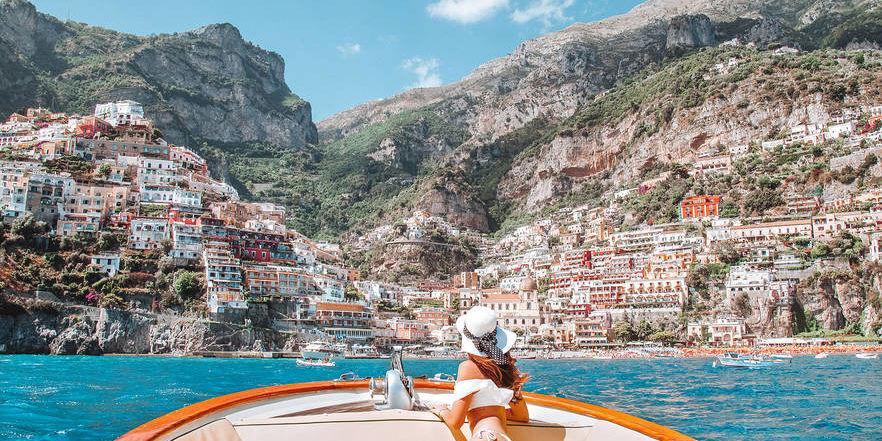
Private Boat Tour: Amalfi Coast & Positano