Positano and Amalfi sit less than sixty kilometers from Naples, and getting to them is the part of a Southern Italy trip that surprises people most. On the map it looks like a short drive. In practice, there is no direct public route: every option by land or scheduled boat involves at least one change, usually in Sorrento, and in high season the coast road turns that short distance into a long afternoon.
The sea route is the one most travelers never seriously consider, and it is often the one that makes the most sense. This guide covers how to reach Positano and Amalfi from Naples by water, how it compares to the road and the ferry, and when arriving by private boat is worth arranging.
Why there is no easy way to Positano by land
The Amalfi Coast was never built to be reached quickly. The single coastal road that connects its towns is narrow, winding, and shared by buses, scooters, and delivery vans, and in summer it carries far more traffic than it was designed for. From Naples, the usual public route runs to Sorrento first, by train or bus, and then onto a second bus or a ferry down the coast. There is no through service that takes you from Naples to Positano in one leg.
That means the real cost of the journey is not distance, it is transfers, timetables, and the chance that one missed connection unravels the rest. A car of your own does not solve it either, because Positano and Amalfi are among the hardest places on the coast to park, and the approach in August can crawl. Understanding this is the starting point for seeing why the water is often the better answer.
What arriving by sea actually changes
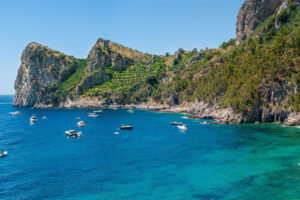
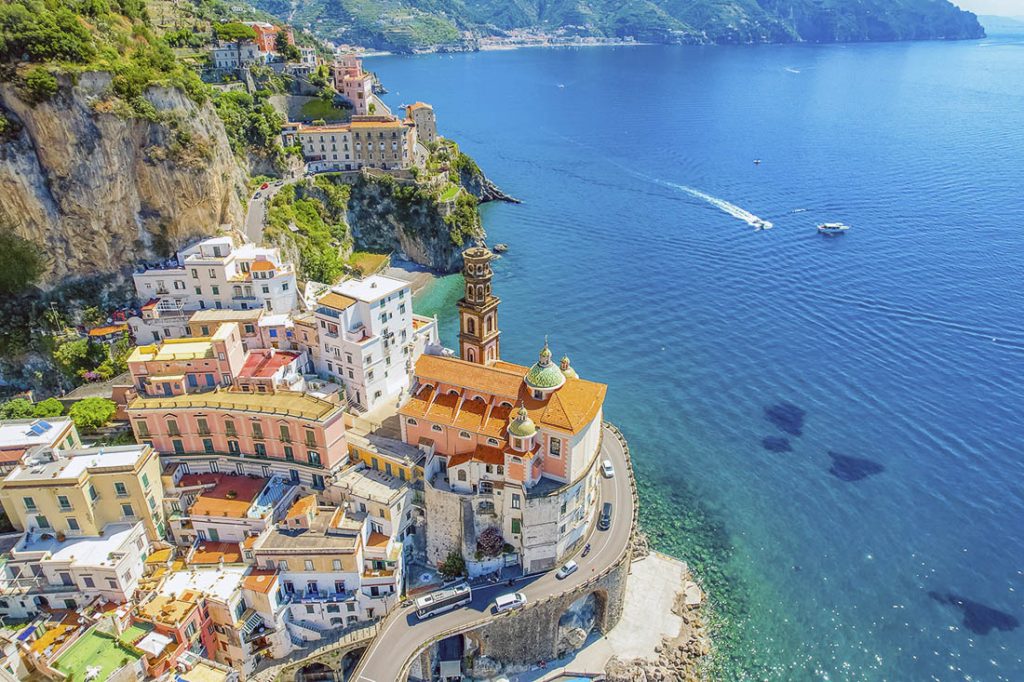
Approaching the Amalfi Coast from the water reverses the whole experience. Instead of descending into a town through switchbacks and traffic, you arrive at it front-on, the way these places were meant to be seen, with the pastel facades of Positano stacked up the hillside and the cathedral of Amalfi framed by the valley behind it. The towns were built facing the sea because the sea was the road. Arriving that way is not a novelty, it is the original logic of the coast.
There is a scheduled ferry from Naples to Positano in the warmer months, and it is a genuine option worth knowing about, though it runs a limited number of times a day and stops for the season. For a fixed point-to-point trip on a public timetable, it does the job. What it does not do is let you leave when you want, stop where you want, or land on your own schedule, which is where a private crossing changes the equation.
Naples to Positano by private boat
A private transfer from Naples to Positano is the only version of this journey with no changes and no timetable. You leave from the pier that suits you, cross the bay directly, and arrive at Positano’s Spiaggia Grande without passing through Sorrento or the coast road at all. On a calm morning the crossing is not dead time between two places, it is the best hour of the day, with the Sorrento peninsula opening to your right and the first of the Amalfi towns coming into view ahead.
It is the arrangement that makes sense for travelers who value their time and their comfort over saving money, for couples who want the arrival to be part of the trip rather than an obstacle to it, and for anyone moving with luggage who does not want to change buses on a hot afternoon. Our private boat transfer service covers this route, and for a sense of what the coast offers once you are there, our longer guide to the Amalfi Coast by boat goes well beyond the crossing itself.
Naples to Amalfi: the longer reach along the coast
Amalfi sits further along the coast than Positano, tucked into a valley that was once the heart of a maritime republic. That extra distance makes the land journey longer still, and it makes the case for the sea even stronger. Arriving by water lets you take in the stretch of coastline between the two towns, past Praiano and the Furore fjord, rather than experiencing it as a series of blind bends from a bus window.
The town’s history is written into its geography: Amalfi faced the sea because its power came from the sea, and the approach from the water is the one that makes that legible. If that history interests you, our piece on the coastal watchtowers and the one on the maritime republic of Amalfi both read differently once you have seen the coast from the angle they were built to watch.

Choosing between the road, the ferry, and a private crossing
Each option answers a different priority, and it is worth being honest about which is which. The bus and train route is the cheapest, and for a solo traveler counting every euro it is the sensible choice, provided you accept the changes and the crowds. The scheduled ferry is a good middle option in season, direct to Positano and scenic, as long as its limited departures fit your day.
A private boat is none of those things and does not pretend to be. It is the option for travelers whose priority is time, comfort, privacy, and a smooth arrival, rather than the lowest fare. It removes every change and every timetable from the journey, and it turns the transfer into part of the holiday. If that is what matters most to you, it is the route that delivers it. If the lowest price is the deciding factor, the public options are there and they work.
Planning the crossing
A few practical points shape a sea transfer to the Amalfi Coast. Sea conditions matter more than on the sheltered run to Capri, because the coast is more exposed, and a private operator will watch the forecast and adjust rather than press on in a swell. Timing matters too: an early crossing avoids both the afternoon wind that often builds along the coast and the busiest hours at the small ports. And luggage, which is a real burden on the bus route, is simply loaded once and unloaded at the other end.
Because every private crossing is arranged individually rather than sold as a fixed package, the sensible way to plan it is to start from your own itinerary, your dates, your departure point, and where you are staying on the coast, and build the crossing around that. Our guide to planning a day by boat from Naples sets out how the distances and timings fit together across the wider bay.
Frequently asked questions
Is there a direct way to get from Naples to Positano?
Not by public land transport. Buses and trains require at least one change, usually in Sorrento. There is a seasonal scheduled ferry direct to Positano with limited departures, and a private boat transfer, which is the only option with no changes and no fixed timetable.
How long does the crossing from Naples to Positano take?
It varies with the vessel, the departure point, and sea conditions, so it is best confirmed at the time of booking rather than quoted as a fixed figure. A direct private crossing avoids the transfers that make the land journey unpredictable in high season.
Is arriving by boat better than driving to the Amalfi Coast?
For most travelers, yes, particularly in summer. The coast road is narrow, heavily trafficked, and hard to park at both Positano and Amalfi. Arriving by sea avoids the road entirely and delivers you to the center of town, though the road remains the cheaper option.
Can I be dropped directly at my hotel?
It depends on the town and whether your accommodation has private dock access, which few do. In most cases you arrive at the town’s main jetty, at Spiaggia Grande in Positano or the central port in Amalfi, a short distance from the center.
What happens if the sea is too rough to cross?
The Amalfi Coast is more exposed than the sheltered route to Capri, so conditions matter more. A private operator monitors the forecast and will reschedule rather than cross in an unsafe swell, which is one reason to plan the transfer with some flexibility in your itinerary.