Ischia does not have a single best season. The right month depends on what you want from the island. Warm water and long swimming days point toward summer. Thermal parks, green landscapes, and a quieter coastline make spring especially appealing. September keeps much of the warmth of August while the island gradually returns to a slower rhythm.
That makes choosing the best time to visit Ischia slightly different from planning Capri or the Amalfi Coast. Ischia is a larger island with several towns, five ports, volcanic beaches, natural thermal water, vineyards, and a coastline that changes noticeably from one side to the other. The season affects not only the weather, but also how much of the island is open and how comfortably you can experience it from the sea.
This guide follows Ischia month by month, looking at weather, average sea temperature, crowds, thermal parks, and what each period means if a day on the water is part of your trip.
The short answer
For most travelers, the best time to visit Ischia is May, June, or September. May gives you a green island, open thermal parks, mild weather, and relatively quiet water, although the sea is still cool. June brings genuine summer conditions without the full intensity of August. September is particularly strong if swimming matters: the sea still carries the heat of summer, while the island becomes gradually less crowded.
July and August offer the warmest water and the most reliable beach weather, but they are also the busiest months. April and October are better for travelers who value quiet, walking, thermal experiences, and flexibility more than guaranteed swimming conditions.
Month by month: what to expect in Ischia
April
April is when Ischia begins to shift from local winter life into its visitor season. Temperatures are mild rather than summery, vegetation is fresh after the winter rains, and the island still feels spacious. Many seasonal hotels, restaurants, beach establishments, and thermal facilities begin reopening during the month rather than on one fixed date.
The major thermal parks illustrate this rhythm well. Their seasons usually begin in the second half of April and continue into October. That makes late April one of the first periods when you can combine the island’s geothermal identity with outdoor travel rather than simply visiting towns and historical sites.
The sea, however, is still cold. The long-term April average is around 60°F (16°C). A sunny day can make the water look like summer, but swimming is usually brief unless you are comfortable in cooler temperatures.
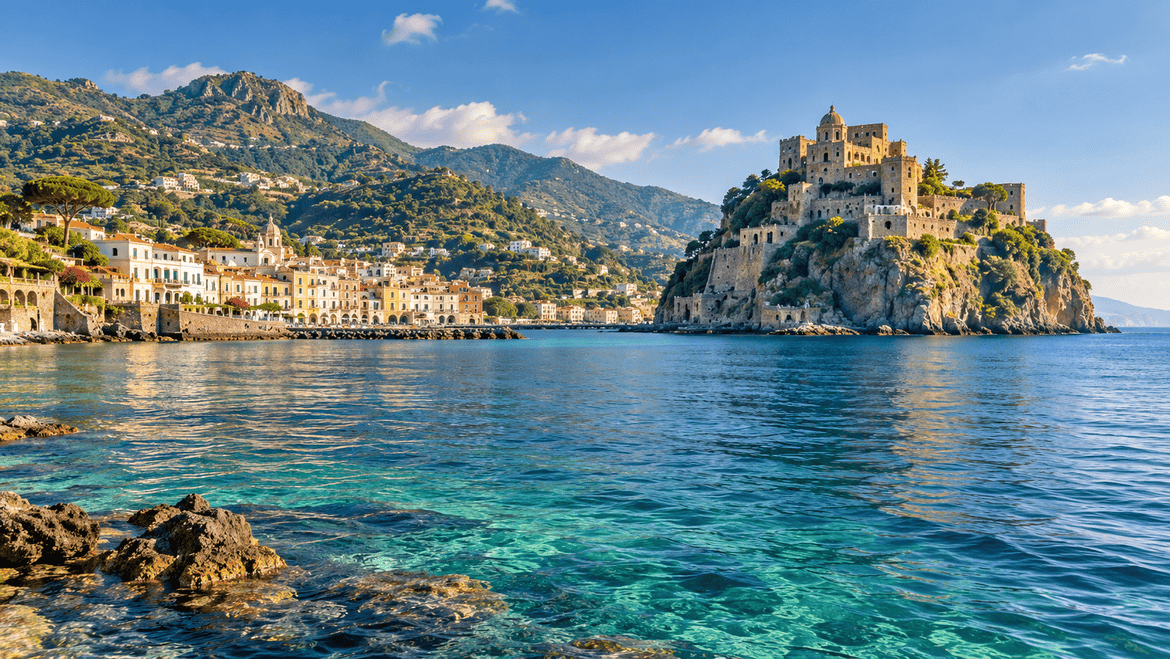
For a boat day, April is about coastline rather than long swims. The approach to the Aragonese Castle from the sea, the volcanic cliffs, and the southern shoreline around Sant’Angelo are rewarding even when nobody wants to spend twenty minutes in the water. The main limitation is weather variability, so plans should remain flexible.
May
May is one of the most balanced months on Ischia. The thermal season is established, the island is fully awake, and the landscape is still green before the driest part of summer. Temperatures are comfortable for walking through Ischia Ponte, Forio, or Sant’Angelo without the heat that makes sightseeing slower in July and August.
The sea averages about 66°F (19°C). Early in the month it can feel distinctly cool, while late May often gives the first genuinely inviting swimming days. For travelers coming from colder climates, that may already be enough. For anyone who wants warm Mediterranean water, June or September is the safer choice.
What May offers instead is space. Bays that will be busy with boats in August are still relatively quiet, restaurant reservations are easier, and thermal parks can be enjoyed without peak-season crowds.
For a private boat day, May is excellent if the purpose is to explore. The southern side of Ischia, from Sant’Angelo toward Maronti and the volcanic coastline around Sorgeto, has more room to breathe. It is also a good month for understanding why Ischia’s thermal springs and volcanic origins shape far more than its spa culture.
June
June is when Ischia begins to feel fully Mediterranean. Days are long, rainfall is much less frequent than in spring, and the sea warms quickly. The monthly average is around 73°F (23°C), with noticeably warmer conditions toward the end of the month.
This is also when the island works particularly well for travelers who want to combine land and sea. Mornings are comfortable enough for a walk through a village or a thermal park, while the afternoon can belong to the coast. Restaurants, beach establishments, and seasonal services are operating normally, but the island has not yet reached its August pressure.
On the water, June is one of the strongest months of the year. Swimming becomes part of the day rather than an optional quick stop, and the long evenings leave more room for an unhurried return. If your idea of Ischia is a mixture of volcanic scenery, lunch near the water, thermal culture, and swimming, June offers very few compromises.
July
July is high season. The weather is dry, the sea averages around 78°F (26°C), and almost every part of the island is operating at full summer pace. Beaches are active, towns stay busy into the evening, and the coast fills with private boats and local traffic.
For travelers focused on swimming, this is close to ideal. The water is warm enough for repeated stops, and the difference between the island’s various coastal zones becomes part of the experience: the open western shore around Forio, the sheltered southern stretches near Sant’Angelo, and the eastern coastline dominated by the Aragonese Castle.
Late July is also traditionally associated with the Festa a Mare agli Scogli di Sant’Anna in the bay of Cartaromana, one of the island’s major maritime traditions. Its exact program and date should always be checked for the year you travel, since weather and sea conditions can affect events held directly on the water.
For a boat day, the main rule in July is simple: start before the coast reaches its busiest point. Earlier hours usually mean quieter swimming locations and more freedom to adjust the route as the day develops.
August
August is Ischia at maximum intensity. The sea reaches its annual peak, averaging about 79°F (26°C), the weather is at its most reliably hot, and the entire island moves to a summer rhythm.
It is also the busiest period. Italian summer vacations add domestic visitors to international tourism, beaches become crowded, popular restaurants need more planning, and road traffic between the island’s towns can make moving on land slower than the map suggests.
None of that makes August a bad time to visit. If warm water, long evenings, and a fully animated island are what you want, August delivers them better than any other month. You simply need to plan differently.
From the water, the advantage is mobility. A private boat is not tied to one beach or one road, so the route can change as conditions and crowds change. Quieter swimming stops can replace the most obvious bays, lunch can be timed away from the busiest period, and a place such as Sant’Angelo can be approached directly from the coastline rather than through the island’s summer traffic.
September
September may be the best single month for travelers who want Ischia primarily for the sea. The water cools slowly after August and still averages about 76°F (24.5°C), warmer than it is in June. Air temperatures ease, evenings become more comfortable, and the island begins to lose the pressure of peak summer.
The change is gradual rather than immediate. Early September still feels very much like summer. By the second half of the month, beaches and restaurants become easier, the rhythm slows, and the island feels more accessible without feeling closed.
Thermal parks remain open, which gives September an important advantage over early spring: you can combine warm seawater, thermal pools, outdoor dining, and active island life in the same trip.
This is also a particularly good month for a boat day. The combination of warm sea and fewer people allows more freedom around the coastline. Stops for swimming can last longer, and places such as the Maronti side or Sant’Angelo regain some of the slower character that defines Ischia outside peak season. If your dates are flexible, the first half of September is especially easy to recommend.
October
October is a transition rather than a sudden end to the season. The average sea temperature remains around 72°F (22°C), which means swimming is still realistic on warm days, particularly during the first half of the month. Air temperatures are milder, crowds fall sharply, and the island feels more local again.
Many thermal facilities continue through at least part of October. Exact closing dates change each year, so anyone traveling specifically for a thermal park should check its current calendar before booking. Seasonal restaurants and hotels also begin closing at different points rather than all at once.
The main variable is the weather. Autumn systems become more frequent, and wind or swell can change a day on the water quickly. October therefore rewards flexibility more than precise advance scheduling.
When conditions cooperate, however, a calm October day is one of the most appealing ways to see Ischia. The water is often still comfortable, anchorages are quieter, and the island’s volcanic coastline is easier to appreciate without the visual noise of high summer.
November to March
Ischia does not disappear in winter. Unlike some highly seasonal coastal destinations, it remains connected to Naples throughout the year, and towns such as Ischia Porto continue to function as real communities rather than seasonal resorts.
What changes is the visitor experience. Most large outdoor thermal parks are closed, many seasonal hotels and beach establishments pause for winter, and the sea becomes a less reliable part of any itinerary. The average water temperature falls toward 57°F (14°C) in February and March.
This does not make winter irrelevant. The Aragonese Castle, villages, food, vineyards, and the island’s year-round thermal identity still give Ischia substance outside summer. Travelers interested in quiet, walking, local life, and wellness may appreciate it precisely because it no longer behaves like a beach destination.
For a leisure boat day, however, winter should not be the foundation of the trip. Weather windows are shorter and less predictable, and availability depends on conditions. If seeing Ischia from the water is important to you, plan between spring and autumn instead.
Ischia month-by-month summary
| Month | Typical air high | Average sea | Crowds | Boat day |
|---|---|---|---|---|
| April | 61°F / 16°C | 60°F / 16°C | Low | Good if settled |
| May | 67°F / 19°C | 66°F / 19°C | Moderate | Excellent |
| June | 74°F / 23°C | 73°F / 23°C | Moderate–High | Excellent |
| July | 78°F / 26°C | 78°F / 26°C | High | Excellent |
| August | 79°F / 26°C | 79°F / 26°C | Peak | Good, start early |
| September | 75°F / 24°C | 76°F / 25°C | Moderate | Excellent |
| October | 69°F / 21°C | 72°F / 22°C | Low–Moderate | Good early month |
| Nov–Mar | 54–63°F / 12–17°C | 57–67°F / 14–19°C | Very low | Weather dependent |
Temperatures are approximate long-term averages, not forecasts. Individual days and individual years can differ, especially in spring and autumn.
Why season matters differently on Ischia
On many Mediterranean islands, seasonality is mostly a question of heat and crowds. On Ischia it affects something more fundamental: which version of the island you experience.
The thermal parks are seasonal. Ischia’s geothermal activity exists year-round, but many of the large outdoor thermal parks operate mainly from spring through October. Their opening calendar therefore becomes part of travel planning in a way that it does not on a conventional beach island.
The island is larger than it first appears. Ischia has several distinct towns and five ports around its coast. Staying in Forio is not the same logistical experience as staying near Ischia Porto or Sant’Angelo. Before booking the crossing, our guide to getting to Ischia from Naples explains why your arrival port matters.
Winter remains possible. Scheduled ferry connections with Naples continue throughout the year, even though individual services and frequencies change by season. That means Ischia can still work as a winter destination, just not as the same trip you would plan in June.
The coastline is part of the island’s identity. Sant’Angelo, Maronti, Sorgeto, Cartaromana, Forio, and the Aragonese Castle do not form one continuous resort strip. Each belongs to a different part of the island. Seeing them from the water makes those distances, and the volcanic geography between them, easier to understand.
The sea makes the difference: choosing a month for a boat day
If a private boat is part of the trip, the best month is not necessarily the hottest one.
May gives you quiet water and uncrowded anchorages, but swimming is still cool.
June is the most balanced early-summer option. The sea is warming quickly, days are long, and the island has not yet reached its busiest weeks.
July and August are best for travelers who want to spend as much time as possible in the water. The trade-off is traffic, demand, and more boats around the best-known stops.
September combines summer sea temperatures with a noticeably calmer island, which is why it works so well for a full day along Ischia’s coast.
October can be exceptional on the right day, but it requires flexibility. The forecast matters more than the calendar.
A private route can focus on Ischia itself or combine it with another island. The Ischia and Procida itinerary stays on the volcanic western side of the Gulf, while the Capri and Ischia itinerary connects two islands with very different landscapes in the same day.
Planning your visit: quick reference
If you are still deciding whether Ischia is the right island for your itinerary, our guide to Capri, Ischia or Procida looks at the differences in atmosphere, coastline, pace, and travel style.
Planning Ischia from the water?
A private day can be built around the island’s volcanic coastline, swimming stops, Sant’Angelo, or a second island. If Ischia is where you are staying rather than simply visiting, a private boat transfer to Ischia can also take you directly to the port that makes the most sense for your accommodation.
Frequently asked questions
What is the best month to visit Ischia?
May, June, and September offer the best balance for most travelers. May is quieter and greener, June brings warm weather and increasingly comfortable swimming, and September keeps the warm sea of summer with fewer crowds than August. If swimming is the main priority, September is particularly strong.
Is September a good time to visit Ischia?
Yes. September is one of the strongest months for Ischia. The sea averages about 76°F (24.5°C), thermal parks and seasonal businesses are still operating, and crowds begin to fall after the August peak. Early September feels like summer, while the second half is generally quieter.
Can you swim in Ischia in May?
You can, but the water is still cool. The average sea temperature in May is around 66°F (19°C), with warmer conditions toward the end of the month. Travelers who prefer genuinely warm water will usually be more comfortable from June onward.
Can you swim in Ischia in October?
Often, especially during the first half of October. The average sea temperature is around 72°F (22°C), so the water retains much of the summer warmth. The main uncertainty is the weather rather than the water temperature, since wind, rain, and swell become more frequent in autumn.
When is Ischia most crowded?
August is the peak month, particularly around the Italian summer holiday period. July is also busy. May, June, September, and early October generally offer more space while keeping most seasonal services open.
Is Ischia worth visiting in winter?
Yes, but for a different kind of trip. Ischia remains connected to Naples throughout the year and its towns continue to function normally, but many outdoor thermal parks, hotels, restaurants, and beach establishments are seasonal. Winter suits travelers interested in quiet island life, history, walking, food, and wellness more than swimming or a boat-centered vacation.
What is the best time for a boat tour around Ischia?
June and September offer the strongest overall balance. June has long days and increasingly warm water before peak season, while September keeps summer sea temperatures after the busiest weeks have passed. May is excellent for quieter coastal exploration, and July and August are best if warm-water swimming matters more than crowds.