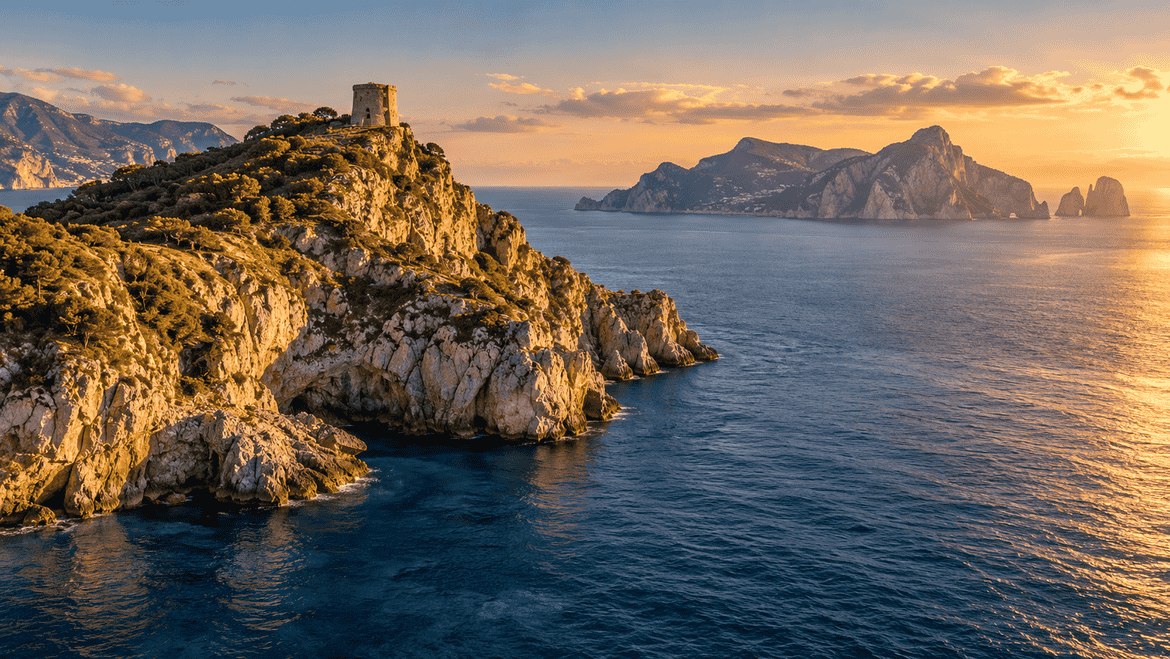
At the far end of the Sorrento Peninsula, the land narrows to a limestone headland facing Capri. There are no colorful houses or waterfront terraces here, only rock, low vegetation, a stone watchtower, and a navigation light above the sea. This is Punta Campanella, a place where the geography of the Gulf of Naples meets a much older history of sailing, belief, and coastal defense.
Its present name comes from a warning bell. Before the bell, the promontory was associated with Athena, the Greek goddess known to the Romans as Minerva. And long before travelers began taking photographs of Capri from these shores, the waters nearby were linked to the story of Odysseus and the Sirens. These are distinct histories, but the headland brings them into an unusually small space.
Where two gulfs meet
Punta Campanella marks the outer tip of the Sorrento Peninsula, where the coastline facing the Gulf of Naples turns toward the Gulf of Salerno. Across a narrow passage lies Capri. The stretch of sea between the island and the mainland is known as the Bocca Piccola, one of the maritime entrances to the Gulf of Naples.
Seen from a map, this is simply the end of a peninsula. Seen from the water, it is a turning point. To one side are the coastal landscapes of Massa Lubrense and Sorrento; to the other, the slopes and inlets that lead toward Nerano and the Amalfi Coast. Capri, which can feel like a separate destination when reached by ferry, becomes part of the same geographical picture.
Its position explains much of its history. A conspicuous headland beside a maritime passage was a natural place for a sanctuary, and later for a tower watching the approaches from the sea.
Before the watchtower: Athena’s sanctuary
In antiquity, the promontory was associated with a sanctuary dedicated to Athena. Greek geographical tradition referred to the place as the Athenaion; in Roman usage, the goddess and the headland were associated with Minerva, giving rise to the name Promontorium Minervae.
That association was not invented by modern tourism. Ancient writers described the sanctuary, and archaeological discoveries have provided material evidence for a cult at the headland. Among the most significant finds is an inscription in the Oscan language, discovered in 1985 on the rock near an ancient approach from the sea. It names officials associated with Minerva and records work connected with the landing or stairway leading toward the sanctuary.
The inscription matters because it ties the sacred place to the practical business of reaching it. Visitors did not encounter the sanctuary in isolation. They approached a coastline, found a landing, and climbed from the water toward a place of worship. The sea was central to the experience, not merely the view beyond it.
As the marine protected area’s archaeological overview explains, offerings and ancient texts support the sanctuary’s presence on the promontory. Its precise architectural form and the identification of individual surviving remains are less certain. There is no intact Greek temple standing beside the tower today, and the later buildings have complicated the archaeological record.
Athena’s association with intelligence and skilled action had particular meaning for sailors. Overlooking the passage toward Capri, the sanctuary connected the practical demands of navigation with the desire for divine protection.
Odysseus and the Sirens: the legend behind the coastline
The other ancient story attached to Punta Campanella is better known. In Homer’s Odyssey, Odysseus must pass the Sirens, whose singing draws sailors toward destruction. Following the advice he has received, he has his companions stop their ears with wax and bind him to the mast so that he can hear the song without steering the ship toward it.
The poem does not identify Punta Campanella as the site of the encounter. Ancient and later traditions associated the Sirens with several places around the Sorrento Peninsula and the neighboring islands. The waters near the headland became one of those settings, while the Li Galli islands off Positano developed a particularly strong connection with the legend.
Another tradition held that Odysseus founded or dedicated the sanctuary of Athena after surviving the passage. It is a compelling explanation for why the hero and the goddess appear together in the local story, but it should not be confused with the archaeological evidence for worship on the headland. The existence of a sanctuary can be studied; the voyage of Odysseus belongs to mythology.
The rocky shore and the passage toward Capri give the story a powerful setting. Punta Campanella does not need to be declared the Sirens’ one true location for the myth to illuminate its maritime landscape.
Why Punta Campanella has its name
The name most visitors use today comes from a much later chapter. In the fourteenth century, under Robert of Anjou, a defensive tower was built on the promontory. Known as Torre Minerva, it occupied a position from which approaching vessels could be observed before they reached the nearby coast.
The tower was substantially rebuilt in the sixteenth century, during a period of repeated raids and insecurity along the shores of the Kingdom of Naples. The attacks on Massa Lubrense and Sorrento in 1558 helped drive the strengthening of a wider coastal warning system.
At Punta Campanella, a bell was used to raise the alarm when hostile ships appeared. The Italian word campanella means a small bell, and over time this everyday object gave the headland the name that displaced the ancient reference to Minerva.
The change of name is revealing: an ancient place associated with protection at sea became known for warning people of danger approaching from it.
The tower is part of a much larger defensive history. For the system of watchtowers, signals, and coastal raids, see our article on the Amalfi Coast watchtowers seen from the sea. At Punta Campanella itself, the stone tower and the nearby navigation light remain the most recognizable man-made features of the headland.
Punta Campanella today: a protected coastline
Today, the headland is part of the Punta Campanella Marine Protected Area, established in 1997. Its importance is not limited to the tower and the ancient sanctuary. Limestone cliffs, underwater habitats, marine vegetation, and coastal wildlife all belong to a landscape that is managed for conservation as well as for visitors.
Protection also means limits. The marine area is divided into zones with different rules. In the most strictly protected sectors, ordinary boat access, navigation, anchoring, and swimming are prohibited unless a specific exception or authorization applies. Other sectors permit certain activities only under conditions set by the managing authority.
For that reason, Punta Campanella should not be presented as an unrestricted swimming or anchoring stop. The fact that a boat can see the headland from permitted waters does not mean it can approach every section of coastline or enter every neighboring bay. For current restrictions, consult the official marine protected area guidance and the applicable notices.
On land, visitors can approach the promontory along the historic path from Termini, following the route traditionally associated with the Via Minervia. The walk leads through Mediterranean vegetation toward views of the tower, the coastline, and Capri. It is an outdoor route over uneven, exposed ground, rather than a conventional sightseeing promenade.
Nearby Baia di Ieranto has its own history of quarrying and conservation, as well as specific access restrictions. It should not be treated as an extension of a boat stop at Punta Campanella.
Understanding Punta Campanella from the sea
Punta Campanella becomes easier to understand when seen in relation to Capri and the two gulfs, rather than as an isolated landmark.
From an appropriate position on the water, the headland reads as a boundary: the mainland tapering away, the island rising beyond the passage, and a tower occupying the point where centuries of sailors would have looked for a landmark. The geometry is simple, but it explains why the same place could carry a sanctuary, a warning system, and a modern navigation light at different moments in history.
For travelers considering a private day around this part of the coast, the Nerano and Capri itinerary connects two destinations in the wider landscape of Punta Campanella. The precise route, viewpoints, and permitted activities depend on the plan agreed with the skipper, the sea conditions, and the rules of the marine protected area. It should not be understood as a promise of close access to the promontory or its restricted waters.
The Sirens belong to myth, the sanctuary to ancient worship, and the bell to the practical dangers of a later age. At Punta Campanella, all three stories look out over the same narrow stretch of sea.