On the road between Positano and Amalfi, Praiano can seem like a place you pass through rather than a place you visit. A few turns reveal the sea, a cluster of houses, and then another bend takes the view away. Yet Praiano is not simply a quieter version of its famous neighbors. Its coastline has two distinct faces, divided by the headland of Capo Sottile. One looks west toward Positano and Capri; the other turns toward Marina di Praia and the eastern Amalfi Coast. To understand what makes Praiano different, it helps to follow that geography rather than the road.
Why Praiano is easy to overlook
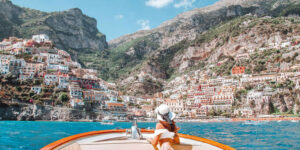
Positano makes an immediate impression. The entire village appears to rise from its beach, with the colorful houses and the dome of Santa Maria Assunta arranged above the water. Amalfi has a harbor and a historic center that draw visitors toward a recognizable arrival point. Praiano is harder to reduce to a single photograph or a single square.
Its houses occupy the slopes well above the shoreline. Streets and stairways connect terraces, small churches, and neighborhoods that do not form one continuous waterfront. The SS163 coastal road offers excellent glimpses of the scenery, but it does not explain how these parts fit together. Even the two best-known beaches belong to different sides of the headland.
That is why Praiano rewards a different kind of visit. Rather than looking for one landmark, follow the shape of the coast. The change becomes especially clear from the water, where the headland, the coves, and the settlements above them can be seen in relation to one another. It is a different coastal story from the one told in our guide to Positano from the sea.
Two sides of Praiano, one coastline
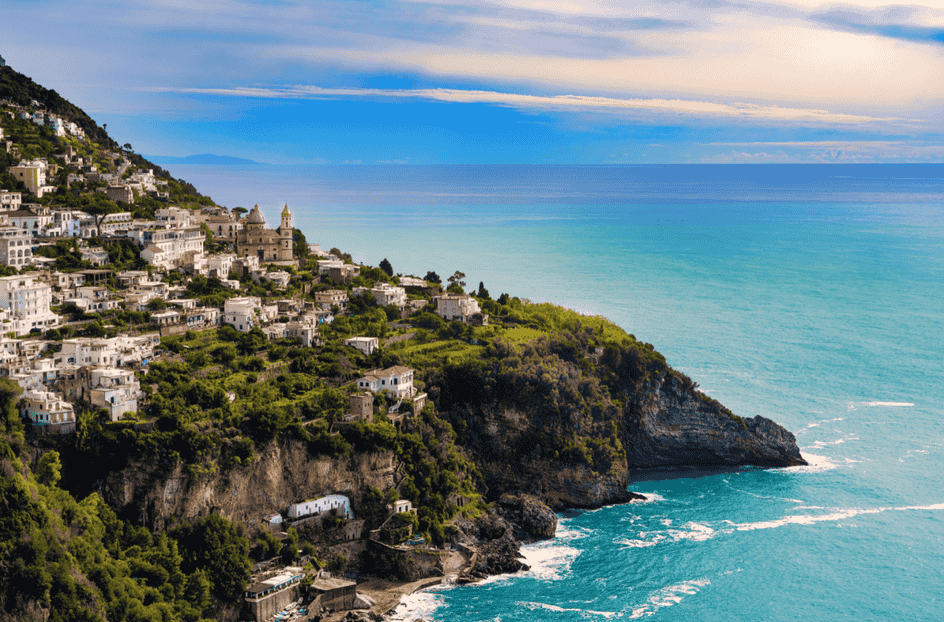
Capo Sottile is the point that makes sense of Praiano’s geography. West of the promontory lies Vettica Maggiore, historically a separate settlement and now part of the municipality. Here the coast opens toward Positano, the outer Sorrento Peninsula, and Capri. The parish church of San Gennaro, with its colorful tiled dome, stands above the shoreline, and the small cove of La Gavitella lies below.
On the other side is Praiano proper. The village rises from the coast toward the church of San Luca Evangelista, while the land descends farther east toward Marina di Praia. From offshore, the difference is visible in the angle of the cliffs and in the way the coves face the sea.
This orientation affects a visit in practical ways. Vettica Maggiore and La Gavitella are known for their western exposure and long afternoon light. The side toward Marina di Praia is more enclosed, with high rock walls creating a very different setting. A plan built around a sunset view is not the same as a plan built around exploring a narrow fishing cove. Both are Praiano, but neither tells the whole story on its own.
Marina di Praia: the village between the cliffs
Marina di Praia is a narrow opening in the limestone coast. Two steep walls of rock frame a small beach at the mouth of the valley, leaving comparatively little space between the buildings, the boats, and the water. Seen from offshore, it is easy to understand why this sheltered-looking recess became important to local maritime life.
Long before Praiano became a vacation destination, the marina was a working landing. Historical accounts record trade taking place here and boats being hauled ashore for repairs as far back as the fifteenth century. Fishing, boat maintenance, and the movement of goods formed part of daily life. Above the cove stands Torre a Mare, a coastal lookout associated with the centuries when communities needed to watch for danger approaching from the sea.
Today, the marina has restaurants, small boats, and a compact beach, but the geography remains the defining feature. The rock walls make the space feel intimate even when summer brings plenty of visitors. The view changes quickly as a boat moves away from the entrance: what looks like a small pocket of beach from shore becomes a break in an otherwise continuous line of cliffs.
One practical distinction matters. Marina di Praia is accessible from the road, with a descending access route toward the beach. It is not a beach that can only be reached by boat. It should also not be confused with the Fiordo di Furore, a separate coastal inlet farther east. Their dramatic rock walls may look related in photographs, but they are different places with different access arrangements.
For the wider history of the defensive structures you can see along this stretch, read our article on the Amalfi Coast watchtowers.
La Gavitella: where the coast faces the sunset
La Gavitella offers almost the opposite perspective. On Praiano’s western side, beneath Vettica Maggiore, the coast opens toward Positano and Capri rather than closing around a narrow ravine. The beach is small, but its exposure gives it a distinctive character: the afternoon sun lingers here later than it does in many coves along the Amalfi Coast.
That matters to anyone choosing when to see this section from the water. In the later part of the day, the view extends across the bay toward Positano, while the outline of Capri sits farther out on the horizon. The scene is less about a monumental village skyline and more about the relationship between light, open water, and the cliffside settlement above.
Reaching La Gavitella from land takes some effort. A long stairway descends from the area around San Gennaro, and the climb back up is worth accounting for, especially in hot weather. Some local waterfront businesses also arrange seasonal boat shuttles or tender access, but these are their own services and may require a reservation.
Arriving off La Gavitella on a private boat does not automatically mean you can disembark. Access to a beach club or landing point depends on local arrangements, availability, and sea conditions. If going ashore is an important part of your day, it should be confirmed before the itinerary is finalized.
Beyond the beaches: the Praiano most visitors miss
The sea explains Praiano’s geography, but it does not contain all of the town’s history. Above La Gavitella, the church of San Gennaro anchors Vettica Maggiore. Its tiled dome is a familiar element in views of the western coastline, yet the surrounding streets and terraces are part of a working village, not simply a backdrop for photographs.
Farther east, San Luca Evangelista occupies a high position within Praiano itself. The separation between these two parish churches reflects the town’s development around distinct settlements rather than a single compact center. Between them are stone stairways, cultivated terraces, and houses adapted to steep ground. Small devotional shrines, often decorated with painted tiles, appear along walls and paths.
Praiano’s identity has never depended solely on tourism. Fishing and maritime trade were important here, but local livelihoods also included agriculture and textile work. The relationship between the upper neighborhoods and the landing places below shaped everyday routines: goods came by sea, while people lived and worked across different elevations of the same hillside.
Praiano’s local character also extends to its food. Away from the waterfront, Ristorante Km0 is a small, intimate restaurant on Via Guglielmo Marconi, led by chef Antonio Satriano Casola. The kitchen draws on seasonal ingredients and traditional local flavors, while the limited seating creates a personal atmosphere. The restaurant also offers customized menus and private dining experiences by prior arrangement. Located within the village rather than directly on the coast, it is an interesting discovery for visitors who want to explore Praiano beyond its beaches.
There is a useful limit to remember when planning a visit. Seeing Praiano from a boat reveals how the town fits the coastline; it does not replace walking through Vettica Maggiore or visiting its churches. The streets above the sea are steep, and reaching them is a separate activity that deserves its own time. A boat day and a visit on foot answer different questions about the same place.
How Praiano fits into a private boat day
On a coastal route between Positano and Amalfi, Praiano should not be treated as empty distance. Moving east from Positano, the shoreline passes the open views around La Gavitella, turns around Capo Sottile, and continues toward Marina di Praia. Farther along lies the Fiordo di Furore. This sequence brings together different types of coast within a relatively short stretch of the journey.
A private boat allows time to appreciate those changes rather than seeing only the larger destinations. Depending on the day’s conditions and the agreed route, that may mean slowing for the view, passing the marina from offshore, or considering a swim in an appropriate area. It should not be read as a promise that every beach can be used as a swimming or landing stop. The skipper must account for sea conditions, local restrictions, and other boats.
If you want to spend time ashore, say so during planning. Marina di Praia and La Gavitella have different access arrangements, and any landing or tender service needs to be checked rather than assumed. Travelers staying in Praiano should likewise confirm their actual meeting or departure point before making plans.
For a related itinerary along the broader coast, see the Amalfi Coast and Positano private boat tour. You can also explore the wider Amalfi Coast destination guide, or discuss a tailored day through our private boat charter service.
Praiano may not have a single defining postcard view. That is its advantage for a curious traveler. Between the open western shore, the narrow marina to the east, and the villages above both, it makes the Amalfi Coast feel less like a sequence of famous stops and more like a place with its own maritime geography.