Most people meet Positano the wrong way around. They arrive by road, step out at the top of the village, and spend the next hour walking downhill through a corridor of boutiques, glimpsing the sea in fragments between walls and lemon trees. By the time they reach the beach, they have seen Positano from the inside, which is a bit like judging a cathedral from the sacristy. The village was built to be looked at from the water, and that is still the only place where it makes complete sense.
Why Positano was built to be seen from the water
Positano is not a town that happens to be near the sea. It is a town that climbs away from it. After centuries of raids from the sea, the population moved steadily up the rock face, building homes along the steep flanks of the valley where stairways and narrow lanes could be defended more easily than an open beach. The three watchtowers that still stand along the shore, Torre della Sponda, Torre Trasita, and Torre di Fornillo, were part of the same logic: watch the horizon, warn the village, buy time.
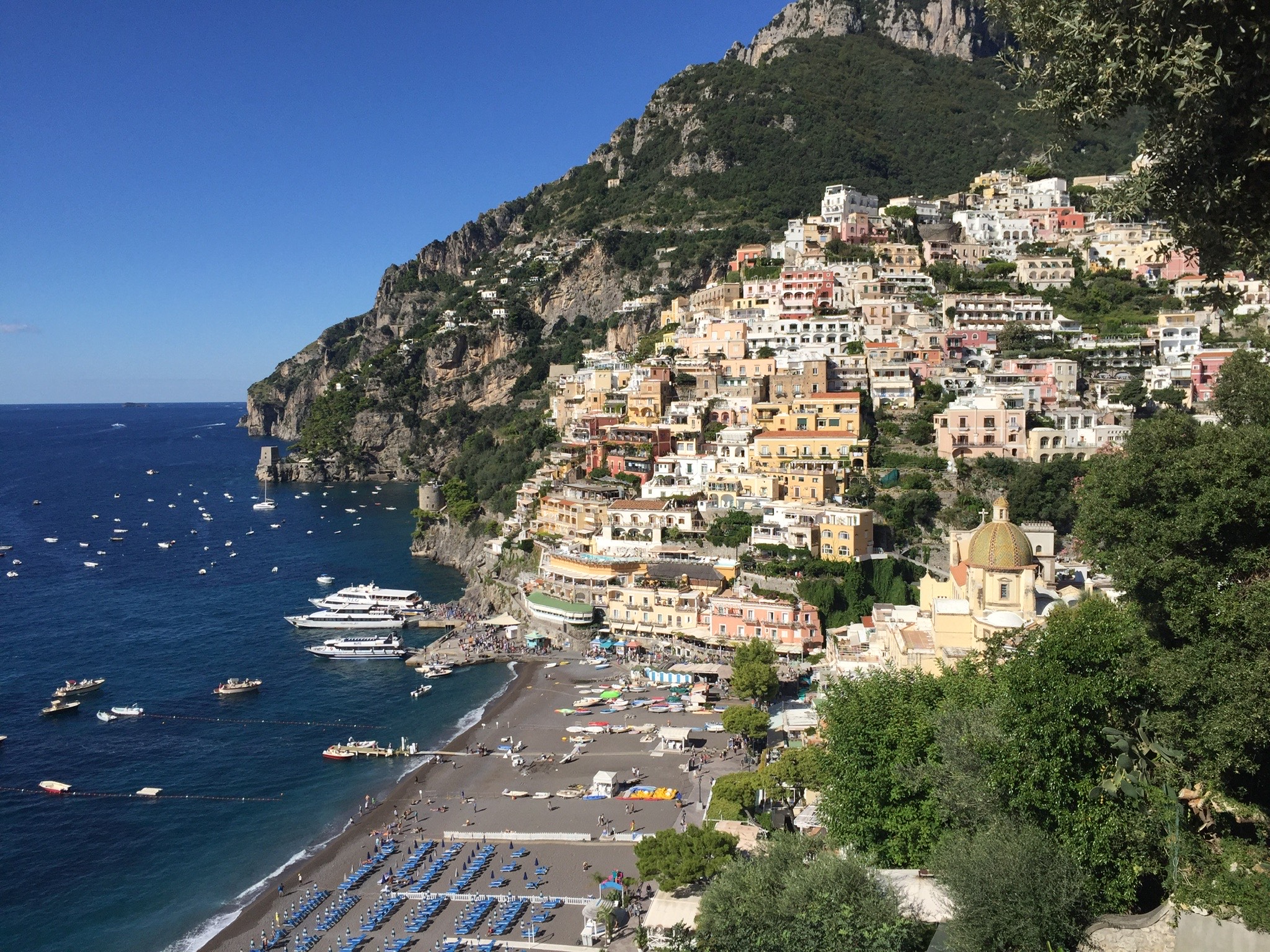
The result is a settlement stacked almost vertically, from the pier up to the hamlets of Montepertuso and Nocelle several hundred feet above. From land you experience this as a lot of steps. From the water you experience it as a single composition, every layer visible at once, framed by the ridge behind it. It is the view Positano was designed to present, whether or not anyone intended it as design.
Reading the village layer by layer
Approach slowly from the open sea and the village resolves in bands, each with its own character.
The lower band: beach and pier
Spiaggia Grande sits at the mouth of the valley, a curve of dark pebbles lined with restaurants and rows of umbrellas. The small pier on its eastern edge is where ferries and private boats come in. This is the busiest part of Positano and, from a distance, the least interesting. Its role in the picture is to anchor everything above it.
The middle band: the dome and the first houses
Just above the beach, the majolica dome of the church of Santa Maria Assunta catches the light in green and yellow tiles. It is the visual center of the village, the point your eye returns to, and the reason so many photographs of Positano are composed around it. Around the church, the oldest houses begin their climb, packed tightly, whitewashed or painted in the pinks, ochres, and pale terracottas that have become the village’s signature.
The upper band: the climb to Montepertuso
Higher still, the houses thin out and the terraces of citrus and vine take over, until the village gives way to bare limestone and the ridge line. On a clear day you can pick out the road switchbacks and the tiny profile of Montepertuso, with its natural rock arch, and further along the cliff edge, Nocelle, the starting point of the Path of the Gods. From the water this whole ascent is one uninterrupted wall of color and stone, and it is genuinely difficult to understand how anyone lives on it.
The landing at Spiaggia Grande
How you arrive changes what you see. Ferries approach the pier directly and unload quickly, which means your first view of Positano lasts a few seconds before you are on the dock with everyone else. A private boat can do something different: hold position off the beach, drift a little, and let the village sit in front of you for as long as you want before deciding whether to go ashore at all.
If you do land, the pier puts you straight onto the beach promenade, a few minutes from the church and the lower village. Many travelers find that an hour or two on foot is plenty. Positano’s charm on land is real, but it is also compact and crowded in season, and the best of it is the return to the boat, when the village reassembles itself behind you as you pull away.
West of the pier: Fornillo and the towers
Turn west from Spiaggia Grande and the coast changes almost immediately. A rocky headland separates the main beach from Fornillo, a smaller, quieter cove that locals have always preferred. Guarding the passage between the two stands Torre Trasita, a round watchtower on the rocks whose first records date to the sixteenth century, now a private residence. On the far side of Fornillo rises a second tower, Torre di Fornillo, also called Torre Clavel after the Swiss writer Gilbert Clavel, who bought and restored it in the early twentieth century and turned it into a meeting place for artists.
Seen from the water, the two towers bracket Fornillo like bookends, and the beach between them looks far more secluded than it feels from the path that connects it to the village. Beyond Fornillo the shoreline continues west with a series of small coves and rock platforms that are reachable only by sea or by long, steep descents. This is the stretch that a road-based visit to Positano never shows you.
East of the pier: Arienzo and the quiet coves
Head east instead and the village ends abruptly at the cliffs. The coast here is a sequence of small beaches tucked below villas and Mediterranean scrub: Laurito, then Arienzo, whose famous three hundred steps make it a commitment on foot and an easy stop by boat. A ruined tower near Arienzo, sometimes called Torre di Renzo, once defended a mill on the beach; little of it remains, but the site marks how far Positano’s defenses once extended.
From the water, this eastern shore is where Positano stops being a postcard and becomes a coastline. The cliffs are higher, the water is deeper and clearer, and the swimming is better than anywhere near the main beach. On a private boat this is the natural place for a first swim, with the village still in view across the bay.
Li Galli on the horizon
Look out to sea from anywhere along this stretch and three small islands sit on the horizon to the southwest. These are Li Galli, the islands of the Sirens, a private archipelago with a tower of its own and a long history of dancers, poets, and myth. Most boat routes along the coast pass close to them, and they are one of the reasons the water off Positano feels less like a beach and more like a stage. We have written about them separately in our guide to Li Galli, the islands of the Sirens off Positano.
How to see Positano from the water with a private boat
Positano is a stop, not a destination on its own, and that is exactly why it works so well by sea. On a private boat the village becomes one movement in a longer day: an approach from the open water, time to hold off the beach, a swim below Arienzo or Fornillo, a landing if you want one, then the coast continuing toward Praiano, the Fiordo di Furore, and Amalfi.
Two of our itineraries pass through Positano in different ways. The Amalfi Coast and Positano tour follows the coastline from Sorrento or Naples, so Positano appears mid-route, framed by the towers and coves on either side. The Capri and Positano tour crosses the open gulf from Capri, which means you see the village emerge from the sea in a single, gradual reveal, the way it appears in the classic photographs. In both cases how long you spend, whether you go ashore, and where you swim are decided on the day, with your skipper, not by a schedule.
If you are staying in Positano, you can also start the day here rather than in Naples or Sorrento, and let the boat take you to Capri or along the coast and back. For a wider view of the coastline and the options around it, see our Amalfi Coast by private boat page, and for the history behind the towers you will pass, our article on the Amalfi Coast watchtowers seen from the sea.