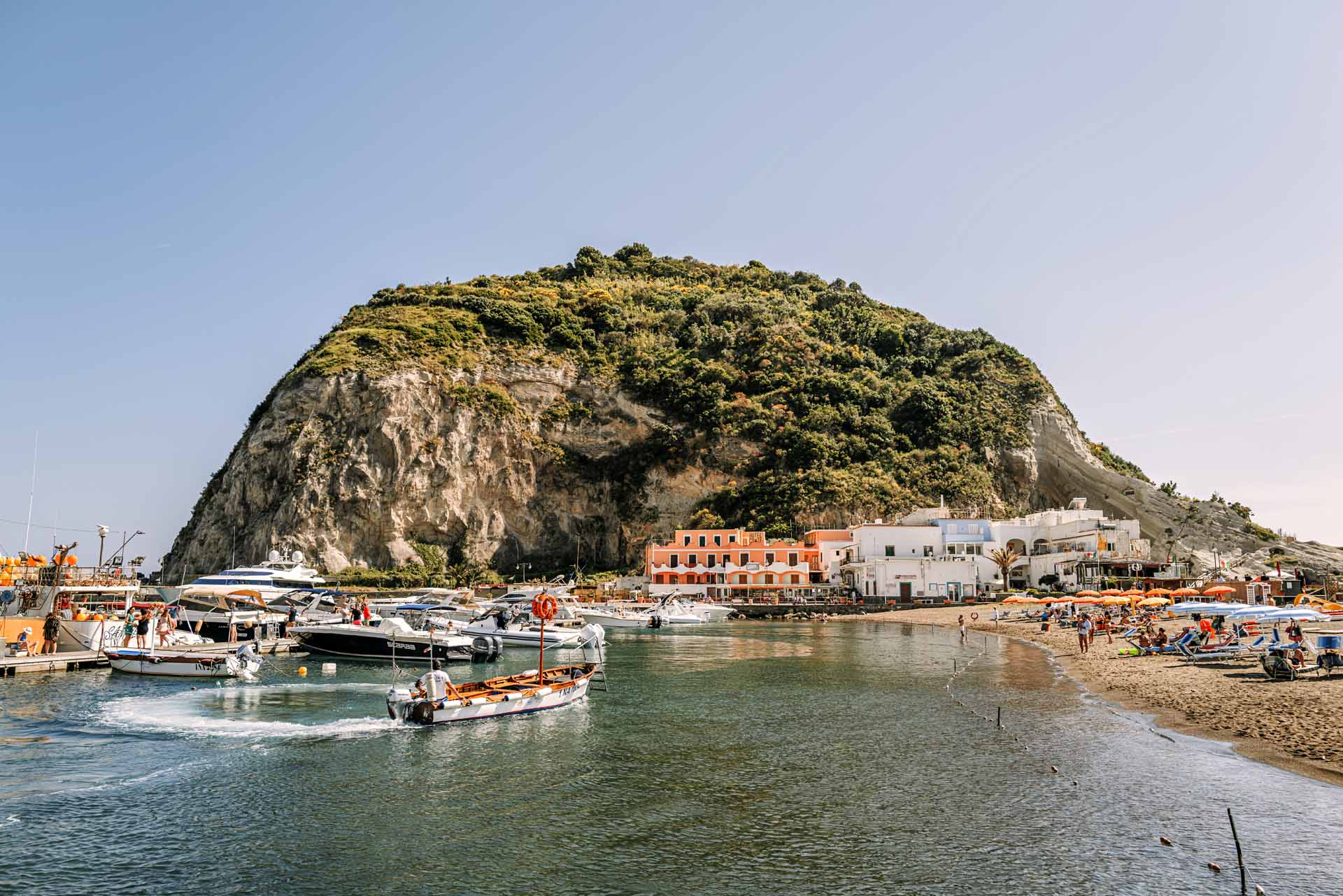
On the southern tip of Ischia, where the island turns its back on the busier resorts of the north, a cluster of pastel houses tumbles down the hillside to a small harbor. This is Sant’Angelo, the island at its most postcard-perfect and, for many who know Ischia well, its most beautiful corner. It is a car-free fishing village that has become a quiet favorite of Italians who arrive by yacht for dinner, and it is defined by a single dramatic feature: a great rock, joined to the village by a thread of sand.
Sant’Angelo is lovely from any angle, but it is not equally easy to reach from every direction. The land approach has a catch that catches out a lot of visitors, and the village makes far more sense arrived at from the water. Here is what it is, and why the sea is the way in.
A village built around a rock and an isthmus
Sant’Angelo belongs to the municipality of Serrara Fontana, on Ischia’s southern coast, and it has always been slightly apart from the rest of the island, a fishing settlement rather than a farming one. Its defining feature is the Torre, a tall islet of tuff stone that marks the southernmost point of Ischia, connected to the village by a narrow isthmus of sand. That sand causeway is both the village’s most photographed view and a working beach, with sheltered water on either side.
The islet takes its name from a watchtower that once stood on its summit, until the early nineteenth century, part of the chain of coastal defenses that ringed these waters against raiders. The tower is long gone, and access to the islet itself is not permitted today, but the rock remains the anchor of the whole scene, the thing your eye goes to first and the reason the village looks the way it does.
Why it is car-free, and what that means for arriving
The heart of Sant’Angelo is entirely pedestrian, closed to traffic. This is a large part of its charm, the reason it feels calmer and slower than the rest of Ischia, but it also shapes how you get there. Cars, taxis, and buses all stop at a designated area above the village, and from there you continue on foot down into the center, with small electric carts available for those who need them.
That final descent is the catch. Arriving by bus or car means a steep walk down from the drop-off point at the top, and then the same climb back up when you leave. On a hot August afternoon, or with any luggage, it is not the gentle arrival the village’s serenity might lead you to expect. It is manageable, but it is worth knowing before you go, because it is precisely the part that surprises people.
Why the sea is the natural way in
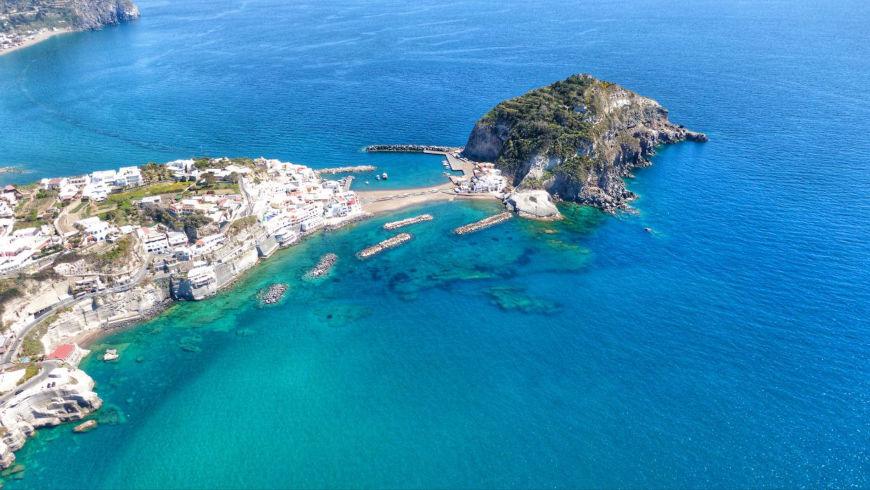
Approach Sant’Angelo from the water and the whole equation changes. Instead of walking down into the village from above, you arrive at its harbor at sea level, exactly where the life of the village is, and the steep descent simply does not enter into it. More than that, the view of Sant’Angelo from the sea, the pastel houses stacked above the harbor and the Torre rising beyond the isthmus, is the definitive one. This is the composition every photograph tries to capture, and it exists fully only from the water.
It is no accident that Sant’Angelo has long been a village people arrive at by boat. Its harbor is the departure point for the water taxis that serve this stretch of coast, running to the Maronti beach, the steaming Fumarole, and the thermal bay at Sorgeto. A place whose own local transport is boats is telling you something about how it is best reached. Scheduled public transport struggles to serve the southern coast well, which is part of why arriving directly by sea makes such a difference here.
What surrounds Sant’Angelo
The village sits at the center of the most rewarding stretch of Ischia’s coast for anyone interested in the island’s volcanic character. A short distance east lies the long beach of Maronti, where volcanic steam vents, the Fumarole, heat the sand. Along the same coast is the thermal bay of Sorgeto, where hot springs meet the sea directly and you can bathe in naturally heated water among the rocks, reachable easily by boat and awkwardly by land.
This is the expression of the same volcanic system that gives the whole island its thermal springs and its identity. Sant’Angelo makes a natural base or waypoint for exploring it, close to the hot springs and the quiet coves that define Ischia’s south, and far from the crowds of the northern resorts.
Seeing Sant’Angelo on a day by boat
Sant’Angelo rewards being seen as part of a day on the water rather than as an isolated stop reached the hard way by road. On a boat itinerary around Ischia it sits naturally alongside Sorgeto, the Maronti coast, and the coves of the south, a place to arrive at the harbor, walk the isthmus, and take in the village from the angle that shows it best, without ever facing the climb down from the road.
Our Ischia and Procida itinerary covers the island as part of a day on the water, and for reaching Ischia in the first place, our guide on getting to Ischia from Naples sets out the options, including why the southern ports like Sant’Angelo are the ones public services reach least well. A private transfer to Ischia can land you close to this side of the island directly. When you are ready to plan, the simplest step is to outline what you have in mind.
Frequently asked questions
Is Sant’Angelo in Ischia car-free?
Yes. The center of Sant’Angelo is entirely pedestrian and closed to traffic. Cars, taxis, and buses stop at a designated area above the village, and you continue on foot down into the center, with small electric carts available for those who need them.
How do you get to Sant’Angelo?
By land, you reach a drop-off point above the village by car or bus and walk down a