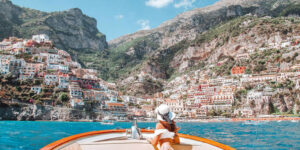
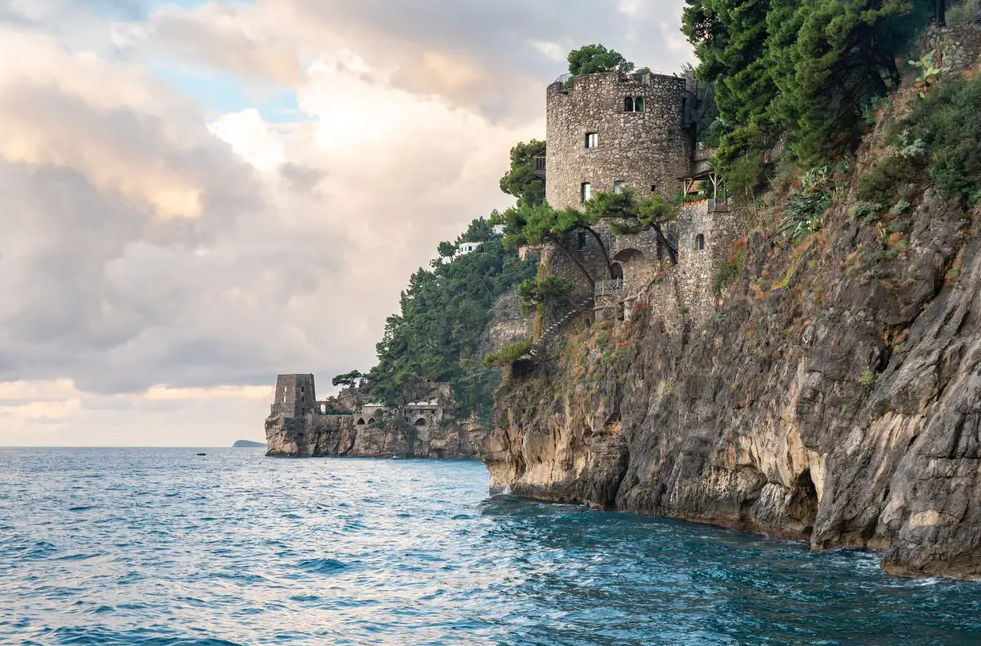
Travel the water between Positano and the tip of the Sorrento Peninsula and you will start to notice them: squat stone towers set into the cliffs, some round, some square, standing where the rock meets the sea. Most visitors passing along the coast road never register them. From a boat, they are impossible to ignore.
These are the Amalfi Coast watchtowers, among the most eloquent and least understood features of the coastline. They were not built for beauty, though many are beautiful. They were built out of fear, and reading them is one of the best ways to understand how this coast actually lived for centuries. Fittingly, several of them can only be fully appreciated from the sea.
What the Amalfi Coast watchtowers actually are
Along the roughly thirty miles of coast between Vietri sul Mare and Positano stand around thirty defensive towers, built in phases and forming a single connected system. The great majority date to the sixteenth century, when the Kingdom of Naples was under Spanish viceregal rule and the coast was exposed to repeated raids by Barbary and Ottoman corsairs. Villages were sacked, and inhabitants were carried off into slavery. The towers were the answer.
The common description of these towers as simply “Norman” or “Angevin” is a simplification. A few do have older origins: Charles of Anjou had towers built on the Li Galli islets and at Punta Campanella between 1332 and 1343, and the Torre Normanna at Maiori is often cited as the oldest on the coast. But the network as we see it today was reorganized under the viceroy Pedro de Toledo in 1532 and placed on full alert in 1563. What looks medieval is, for the most part, the product of an early modern arms race against pirates that lasted, in various forms, from the ninth to the seventeenth century.
How the warning system worked
The towers were not identical, because they did different jobs. The tall, slender round towers were placed on the highest and most exposed points, and their purpose was to see. The squarer, heavier towers were built to hold a small garrison and to defend. Together they formed a chain in which each tower could see the next.
The signaling itself was simple and effective. By night, fires were lit on the tower terrace, and the number and rhythm of the flames told neighboring towns what kind of threat was approaching. By day, particular bells were rung, and mounted messengers known as cavallari rode from village to village to raise the alarm. Often the corsairs, seeing the fires, changed course. Not always.
The watchtowers you can only see from the sea
Because their job was to watch the water, most of these towers were built on promontories and cliff spurs that face the open sea rather than the land. From the coast road, the SS163, many are hidden behind the rock or glimpsed only for a second between one curve and the next. From a boat, they line up exactly as they were meant to be read.
The stretch between Positano and the end of the peninsula is the richest. Positano alone has the Torre Sponda, the Torre Trasita, and the Torre di Fornillo, each set into a different fold of the coast. Just offshore, the tower on the largest of the Li Galli islets guards the small archipelago long tied to the legend of the sirens, and the line of defenses continues west toward Punta Campanella, the old boundary between the Amalfi and Sorrento coasts. Our guide to Li Galli, the islands of the sirens off Positano, covers that particular corner in more detail.
Torre Clavel, a watchtower reborn as a work of art
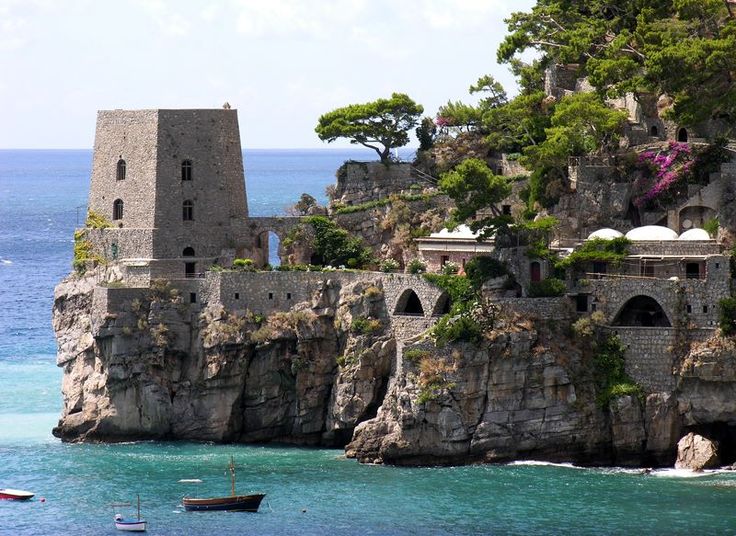
Not every tower kept its military life. The most remarkable second act belongs to the pentagonal Torre di Fornillo at Positano, built in the 1530s and known today as the Torre Clavel. In 1909 it was bought, for a modest sum, by Gilbert Clavel (1883 to 1927), a Swiss aesthete, archaeologist, and Egyptologist from a wealthy family of industrialists.
Clavel did not build the tower. He rescued a half-ruined coastal watchtower and reimagined it entirely. He was drawn, above all, to its unusual five-sided plan, which reminded him of the pyramids he had studied on his travels in Egypt. Over the years he transformed the tower into a house and private museum, a personal work of art carved into the rock above the sea. After his death it passed through other hands, and in 1954 it was acquired by Princess Santa Borghese Hercolani, who preserved it much as Clavel had conceived it.
The 1920s: a coast of artists and thinkers
Under Clavel, the Torre di Fornillo became a gathering place for the European avant-garde. Through the 1920s the tower drew a remarkable circle of writers, painters, and musicians: Fortunato Depero, Pablo Picasso, Jean Cocteau, Filippo Tommaso Marinetti, Enrico Prampolini, and the writer Norman Douglas, among others. Clavel himself was close to the Futurists, and with Depero he had conceived the Balli Plastici, a pioneering marionette spectacle staged in 1917.
There was a quieter, and in retrospect more poignant, thread as well. In September 1925 a group of young German intellectuals, several of them of Jewish background, spent time in Naples, Capri, and Positano: Theodor Adorno, then a composition student, together with Siegfried Kracauer, Walter Benjamin, and Alfred Sohn-Rethel. It was here that Benjamin met the Latvian director Asja Lacis, an encounter that would shape his thinking for years. The landscape of the gulf worked its way into their writing, and within a decade the rise of Nazism would drive several of them into exile. That this stretch of coast could hold both a Futurist’s fantasy and the early work of some of the twentieth century’s most influential thinkers says a great deal about its pull.
Seeing the watchtowers from a private boat
The watchtowers were designed to be seen from the water, by the people they were meant to warn and by the ships they were meant to spot. That is still the best way to see them. From a private boat you can follow the whole chain as it was intended to be read, pause beneath the Torre Clavel, drift off the Li Galli islets where the older defenses still stand, and swim in the same coves the corsairs once approached.
A private tour also means you set the pace. There is time to linger where a tower catches the late light, to hear the story behind it, and to move on only when you are ready. Our Amalfi Coast and Positano itinerary follows much of this stretch, and the wider Amalfi Coast by boat guide sets out how a day on the water is planned. For the deeper history of why this coast lived and defended itself by sea, our editorial on the maritime republics of Italy offers the broader context.