Capri is one of those rare places that changes completely depending on how you approach it. Walk its streets and you’ll find designer boutiques, crowded piazzettas, and the polished glamour the island is famous for. Step onto a boat, and a different Capri appears: a coastline of vertical cliffs, sea caves carved into pale rock, and quiet coves you’d never guess were there from the village above. For most travelers, the island makes sense only when seen from both sides. This guide focuses on the side fewer visitors experience: Capri from the water.
Why Capri Is Best Experienced from the Sea
The shape of Capri tells you everything you need to know. The island rises sharply out of the Tyrrhenian, ringed by cliffs that drop straight into deep blue water, with grottoes, arches, and natural pools scattered along its perimeter. Many of the island’s most photographed places, including the Faraglioni, the Blue Grotto, the Green Grotto, and the Lovers’ Arch, exist on the water line and are simply invisible from the streets above. There is also a practical reason. In summer, the road that loops Capri and Anacapri is narrow, crowded, and slow, and the line for the funicular from Marina Grande can stretch well beyond what most travelers expect. A boat removes all of that. You move at your own pace, stop where you want, and see the island in the order that makes sense for the day, the weather, and the light.
The Blue Grotto: Visiting Capri’s Most Famous Cave
The Blue Grotto, or Grotta Azzurra, is the single most recognized natural site on the island and one of the most photographed sea caves in the world. The phenomenon is simple and strange at once: sunlight enters the cave from an underwater opening, passes through the water, and reflects upward, filling the interior with an intense, almost electric blue light. It only works on calm, bright days, and even then, only for part of the morning and early afternoon.
How the Visit Actually Works
You cannot enter the Blue Grotto on your own vessel. Access is managed by a small fleet of local rowboats that ferry visitors in groups of four through a low opening just under a meter high. From a private boat, the routine is straightforward: you arrive at the entrance, wait briefly in line on the water, transfer onto a rowboat, lie back as the oarsman pulls you through the opening, and spend a few minutes inside the cave before returning. There is a separate ticket and rowboat fee, paid on site and not included in tour prices.
When to Go to Avoid the Crowds
The grotto is busiest between mid-morning and early afternoon, especially in July and August, when ferries from Naples and Sorrento converge on the island at the same time. Arriving early, ideally as part of a private boat tour to Capri that starts before the day-trip crowds, gives you a much shorter wait and better light inside the cave. On windy days the entrance is closed for safety, which is one of the reasons traveling with a flexible itinerary matters: a good captain will reroute the day rather than waste an hour waiting.
The Faraglioni and the Lovers’ Arch
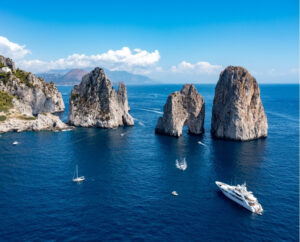
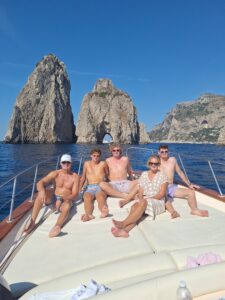
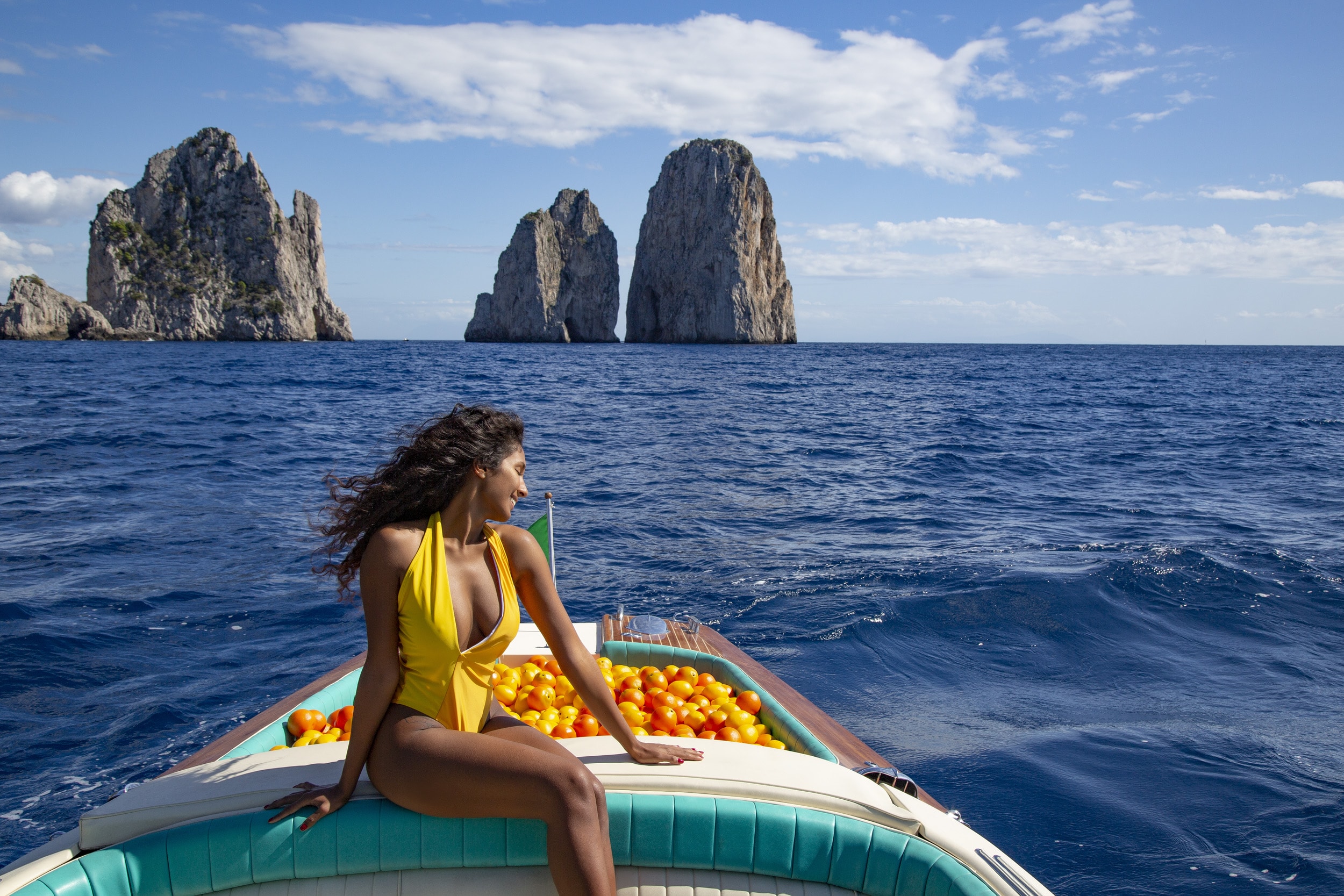
The Faraglioni are the three limestone stacks rising from the sea off the southeastern tip of the island. Each has its own name: Stella, the one still attached to land; Faraglione di Mezzo, the one with the natural arch through its center; and Scopolo, the outermost, home to a small population of blue lizards found nowhere else in the world. Sailing between them is one of the defining moments of any day on the water around Capri. Local tradition holds that couples who kiss as they pass under the arch in the middle stack will stay together. It’s the kind of detail tour operators love to repeat, but it’s also genuinely part of the island’s folklore, and most captains will slow the boat at exactly the right moment to let you decide what to do with it. Beyond the Faraglioni, the coastline opens onto a stretch of sheer cliffs and small inlets that lead toward Punta Tragara, one of the most photographed views in southern Italy.
Hidden Coves and Swim Stops Around the Island
Capri’s coastline is short, roughly seventeen kilometers, but densely packed with places worth stopping. A well-planned day on the water moves between sea caves, swim spots, and quiet stretches of cliff where the water turns from sapphire to pale turquoise depending on the depth of the rock below.
Grotta Verde and Grotta Bianca
The Green Grotto and the White Grotto sit on the southern side of the island, away from the busier northern stretches. Grotta Verde takes its name from the way the light filters through the water into a cave with a wide, open mouth, producing a soft emerald glow. Grotta Bianca, further along, is named for the pale limestone formations that line its interior. Both are accessible only by small private boats and rarely appear on standard ferry routes.
Marina Piccola and the Scoglio delle Sirene
Marina Piccola, on the southern side of the island below the Carthusian Monastery, is the most beloved swimming area for locals. At its center sits the Scoglio delle Sirene, the Rock of the Sirens, traditionally identified with the mythical creatures who tried to lure Odysseus from his course. It’s a good place to anchor for a swim with a view back toward Monte Solaro, and the water here is calm in most conditions.
Punta Carena and the Lighthouse Coast
On the western tip of the island, Punta Carena is marked by a working lighthouse and a wide, rocky coast that catches the afternoon sun longer than any other side of Capri. The water is exceptionally clear, the cliffs are dramatic, and the crowds thin out noticeably. It’s the natural choice for a late-afternoon swim before turning the boat back toward Marina Grande.
Capri’s Two Marinas and What They Tell You About the Island
Capri has two ports, and they explain the personality of the place better than any guidebook. Marina Grande, on the northern side, is where the ferries land, where the funicular leaves for the main town, and where the daily flow of visitors arrives and departs. It is busy, practical, and entirely modern in its rhythm. Marina Piccola, on the opposite side of the island, is smaller, slower, and almost entirely residential and recreational. Locals swim here. Restaurants face the Faraglioni. The pace shifts. A day by boat naturally connects the two, and seeing them in sequence gives you a sharper sense of how the island actually lives, beyond the Piazzetta.
Sunset from the Water: The Last Hour Off Capri
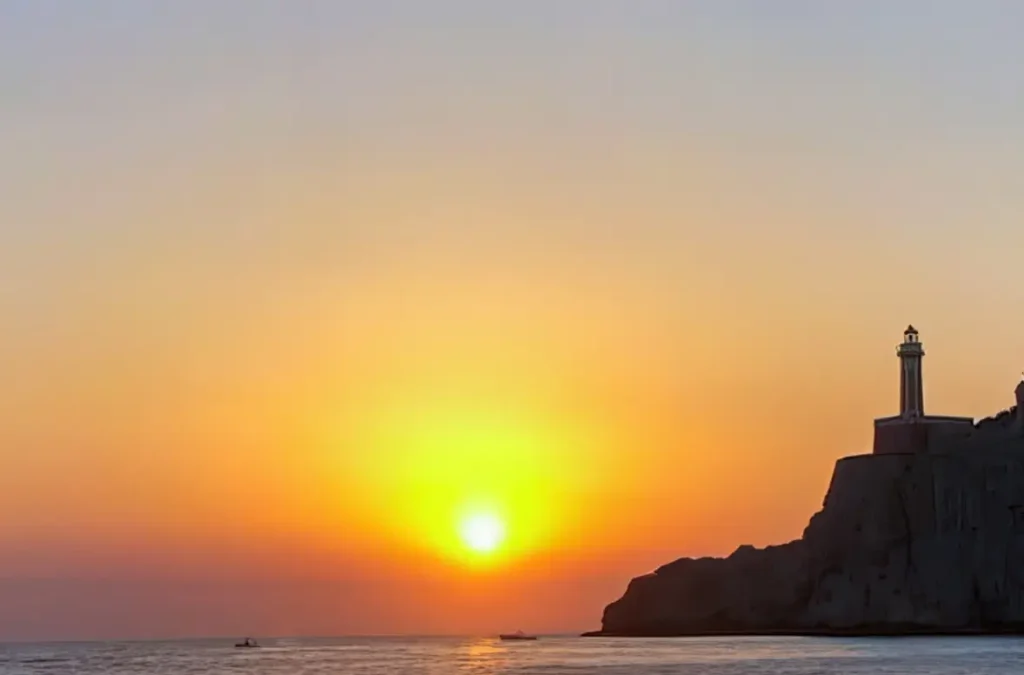
The final hour of light around Capri is, for many travelers, the part of the day they remember most. The cliffs on the western side catch the sun directly, turning a warm gold against the deeper blue of the late-afternoon sea. The crowds at the Blue Grotto are gone. The ferries have begun to head back to the mainland. The water flattens. A slow loop past Punta Carena, the Faraglioni, and into the calmer waters off Marina Piccola is the most cinematic way to close a day on the island, and one of the clearest arguments for being on a boat that can wait for the light rather than chase a schedule.
How to Plan a Day by Boat Around Capri
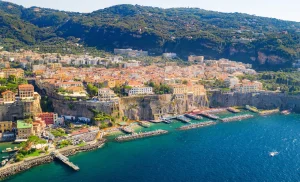
A full day around Capri usually runs between seven and eight hours on the water, with departure points along the Bay of Naples and the Sorrento Peninsula. From Naples, the route crosses the bay directly and typically includes pickup from your hotel or accommodation; this is the most common option for travelers staying in the city or arriving by cruise, and you can read more about how it works on our private boat transfer page. From Sorrento or Positano, the crossing is shorter, leaving more time for swim stops and the full island loop. The right departure depends on where you’re staying, how much time you want on Capri itself, and whether you’d like to combine the island with a stop on the Amalfi Coast, a pairing covered in detail on our Capri and Positano itinerary. The essentials to bring are simple: swimsuit, light cover-up, sunscreen, soft-soled shoes for boarding, and a good camera. Everything else, including towels, snorkeling gear, drinks, and the route itself, is part of the service on a properly run private tour.