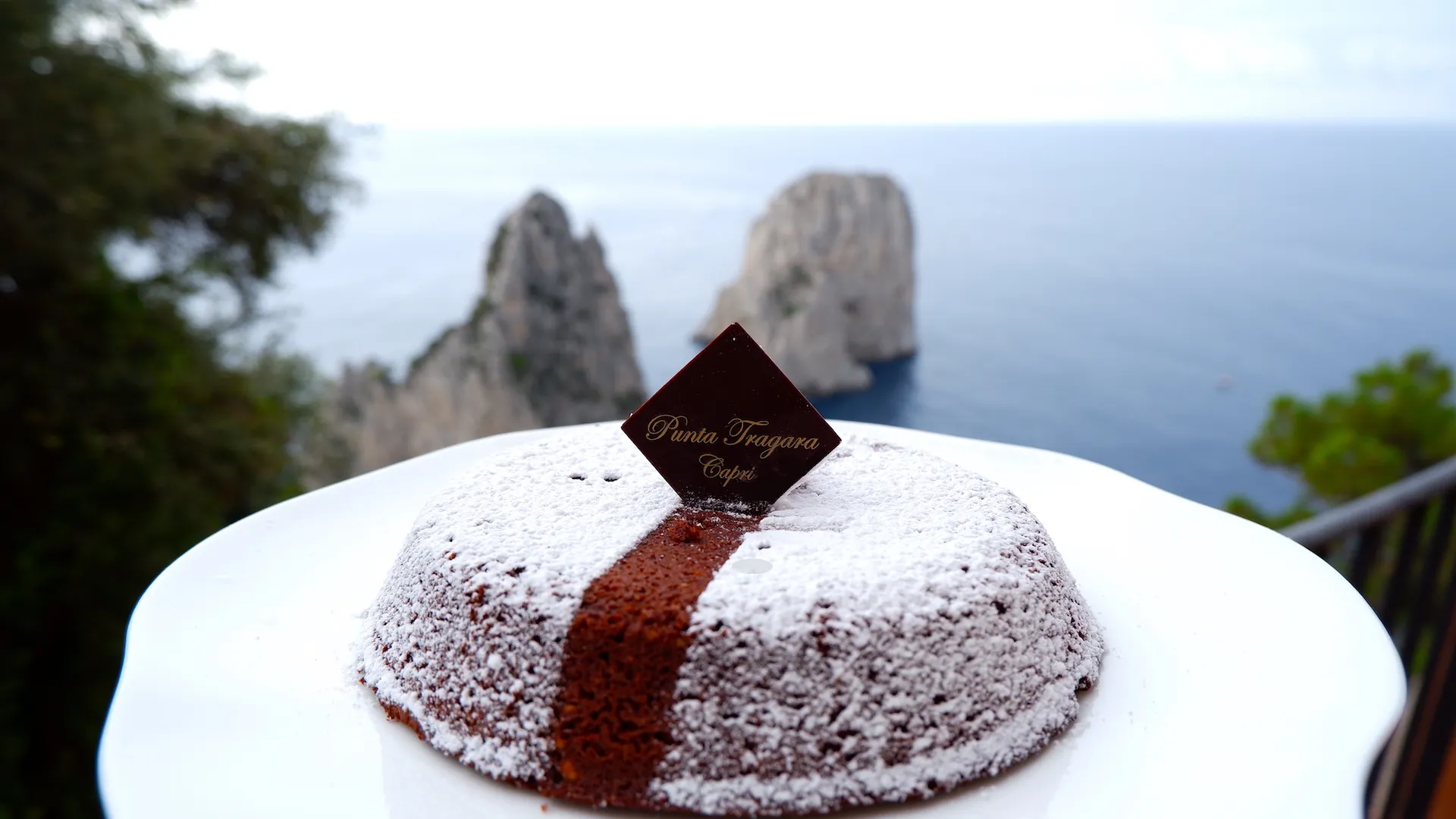
The Torta Caprese is one of the most iconic desserts of Southern Italy, and one of the few that travelers actively seek out by name when they reach the island. Its simplicity often hides a layered history rooted in Capri’s cultural and gastronomic identity. At first glance, it is a straightforward chocolate and almond cake. In reality, it represents a turning point in Italian pastry-making, where scarcity, intuition, and local ingredients converged into something timeless.
Unlike many Italian desserts that rely on flour, the Caprese cake is naturally gluten-free, long before dietary trends made this a selling point. This characteristic is not a modern adaptation but an essential part of its original identity, closely tied to the island’s ingredients and historical context.
Origins: between legend and historical context
The most widely accepted origin of the Caprese cake dates back to the early decades of the 20th century, during a period when Capri had become a refined retreat for intellectuals, artists, and international elites. According to tradition, the cake was created almost by accident by a pastry chef who forgot to add flour while preparing a dessert for demanding guests. The result, far from being a failure, revealed a dense yet delicate texture, with a crisp outer layer and a moist interior.
Another narrative links the cake to the presence of foreign visitors, particularly from Central Europe, who were accustomed to almond-based pastries. Almonds, abundant in Campania, naturally replaced flour, blending local produce with external influences. Regardless of which version one believes, the cake’s birth reflects Capri’s role as a cultural crossroads rather than an isolated island.
What matters more than the anecdote is the context: a place where culinary experimentation was encouraged, ingredients were limited but high-quality, and tradition was shaped by encounters rather than rigid rules.
The essential ingredients and why they matter
A traditional Caprese cake is made with very few elements: dark chocolate, finely ground almonds, butter, sugar, eggs, and a touch of cocoa powder. No baking powder, no flour, no unnecessary additions.
Each ingredient has a specific function. The almonds provide structure and moisture, replacing flour entirely. The chocolate must be dark, with a high cocoa percentage, to balance the sweetness and create depth. Butter contributes richness, while eggs bind the mixture without making it heavy.
The absence of flour is not simply a technical detail; it defines the cake’s character. The texture should never be dry or spongy. A proper Caprese cake is compact, slightly crumbly on the outside, and almost creamy at the center when freshly baked.
Traditionally, the cake is finished with a light dusting of powdered sugar, applied only after it has completely cooled. Any decoration beyond that is considered unnecessary and, in some circles, inappropriate.
From Capri to the mainland: diffusion without standardization
Over time, the Caprese cake spread from Capri to Naples and the rest of Italy, becoming a staple in bakeries and restaurants. However, this diffusion often came at the cost of standardization. Many versions added flour to stabilize production, baking powder for volume, or replaced almonds with cheaper alternatives.
These adaptations made the cake easier to reproduce on a large scale but gradually distanced it from its original identity. As a result, tasting a Caprese cake today does not always mean experiencing the authentic version.
On the island itself, the distinction between a traditional Caprese cake and a commercial interpretation is still very clear. Locals tend to recognize authenticity immediately, not through presentation, but through texture, aroma, and balance.
Where to taste an authentic Caprese cake on the island
On Capri, the Caprese cake is everywhere, but the authentic version is concentrated in a small number of historic establishments where the recipe has been refined across generations. The shops below are spread across both Capri town and Anacapri, the two distinct municipalities of the island, and are the most consistent references for travelers who want to taste the cake as it was conceived rather than as it has been adapted for mass production.
Bar Pasticceria Da Alberto, Via Roma (Capri)
Founded in 1946 by Alberto Federico, a former pastry chef on the transatlantic liner Rex, Bar Da Alberto is the most cited reference on the island for the traditional Caprese cake. Now run by the third generation of the same family, the pastry shop sits at Via Roma 9, a few steps from the funicular terminal that connects Marina Grande to the Piazzetta.
The Caprese cake here is baked on site in small batches and served plain, with only a dusting of powdered sugar. Both the classic chocolate-almond version and the lemon variation, Caprese al limone, are available year-round. For travelers arriving by boat at Marina Grande, this is the closest authentic stop after the funicular ride up to the town.
Pasticceria Buonocore, Via Vittorio Emanuele (Capri)
A short walk from the Piazzetta along Via Vittorio Emanuele, Buonocore has been in its current location since 1973, though the family’s presence on the island dates back to 1950. The shop combines a gelateria, a pasticceria, and a small tavola calda under one address, and is best known to locals for the cialde, the crisp waffle cones made fresh throughout the day.
The Caprese cake at Buonocore is offered in both the classic chocolate-almond version and a Caprese al limone made with almond paste and Capri lemons. The shop also produces the Caprilù, a smaller almond-and-lemon cookie that has become a recognizable Capri-specific specialty in its own right.
Bar Grotta Azzurra, Via Giuseppe Orlandi (Anacapri)
For travelers who reach the upper side of the island, Bar Grotta Azzurra in Anacapri has been a fixed reference for the local Caprese cake since 1970. The pastry shop sits on Via Giuseppe Orlandi 208, at the crossroads that connects the pedestrian center of Anacapri to the bus stops for the Grotta Azzurra, the Faro di Punta Carena, and Monte Solaro. The laboratory is on display behind the counter, with pastries, breads, and gelato produced on site throughout the day.
Beyond the classic version, Bar Grotta Azzurra also serves the Torta Anacaprese, a local variation made with white chocolate and Capri lemons instead of dark chocolate. This is the version that distinguishes the upper side of the island from Capri town, and tasting both during a single day is one of the simpler ways to understand the small but real differences between the two municipalities.
Beyond the historic shops: traditional restaurants on the island
Several restaurants on Capri serve a Caprese cake that meets the traditional standard, usually as part of a longer menu rather than as the main attraction. The clearest sign of authenticity is the texture: the cake should be dense without being dry, compact at the edges, and almost creamy at the center. A Caprese cake that arrives sliced thin and uniform, with a flat top and no visible crackling on the crust, is almost always an industrial product.
For travelers building a day on the island, the most reliable approach is to ask whether the cake is baked on site and whether the almonds are ground in-house. Both questions are routine, and a restaurant proud of its dessert will answer clearly.
Tasting the Caprese cake as part of a day on Capri
For most travelers, the Caprese cake is not the reason to come to Capri, but it is one of the small details that make a day on the island feel complete. The cake works best as a closing note: after lunch at Marina Grande or Marina Piccola, before the afternoon climb back to the Piazzetta, or as a slow pause at the end of a boat day, when the light begins to soften over the Faraglioni.
Travelers who reach Capri by private boat from Naples, Sorrento, or Positano often have the flexibility to plan the day around these small culinary moments rather than around fixed tour schedules. A stop at Da Alberto on the way up from Marina Grande, a coffee at the Piazzetta, an afternoon return to the boat for a swim near the Grotta Bianca: this is the rhythm the island was originally designed for, and the Caprese cake fits naturally into it.
For broader context on how a Capri boat day is typically structured, the Naples by sea hub covers the most common departure points and routes across the Bay of Naples.
How and when it is traditionally served
The Caprese cake is not associated with elaborate rituals. It is typically served at room temperature, never warm, often accompanied by a simple espresso or, less commonly, a small glass of liqueur.
In traditional settings, it is not paired with creams, sauces, or ice cream. These additions are modern interpretations that shift the focus away from the cake itself. The original intent was to let the contrast between the bitter chocolate and the sweetness of almonds speak on its own.
On Capri, it is often enjoyed in the afternoon, as a pause rather than a conclusion, aligning with the island’s slower rhythm and understated elegance.
More than a dessert: a reflection of place
The enduring appeal of the Caprese cake lies in its coherence with the island that created it. Like Capri itself, it appears simple but reveals complexity over time. It resists excess, values balance, and rewards attention.
For travelers, tasting an authentic Caprese cake is not just a culinary experience but a cultural one. It offers insight into how local traditions survive through restraint rather than spectacle, and how true quality often depends on what is intentionally left out.
In a landscape where Italian desserts are increasingly reinvented for visual impact, the Caprese cake remains quietly unchanged. And it is precisely this fidelity to its origins that continues to make it relevant today.