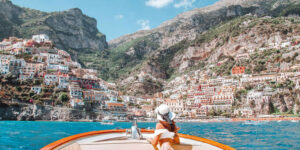
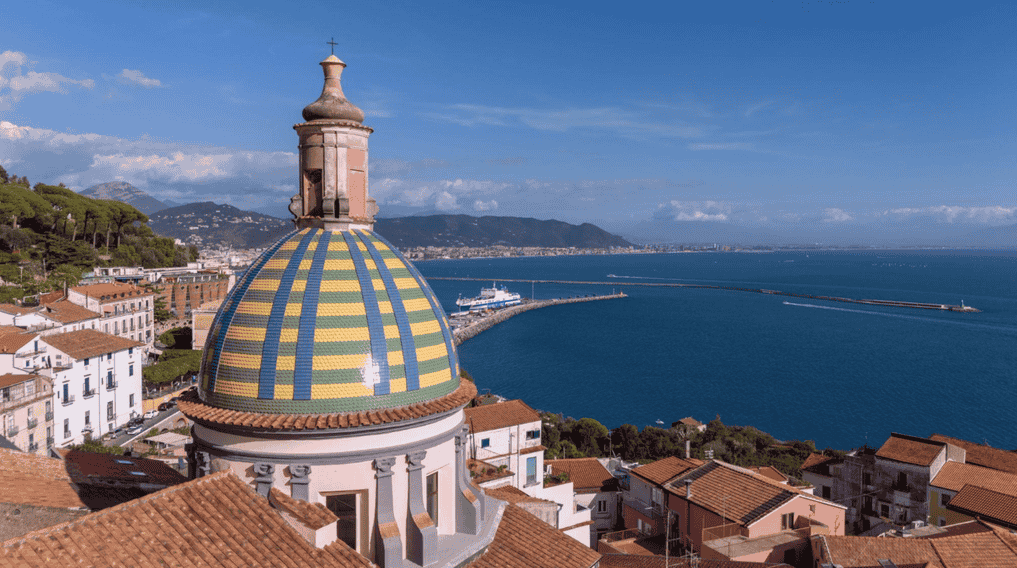
At the eastern end of the Amalfi Coast, Vietri sul Mare has a different claim to recognition. Positano is known for its houses rising above the beach, and Amalfi for its maritime history. Vietri is known for something made by hand: ceramics. Glazed tiles appear on walls and facades, plates fill shop windows, and the dome of the Church of San Giovanni Battista carries the town’s colors above the rooftops. Here, pottery is not simply something visitors buy. It is part of how the town looks and how generations of its residents have worked.
To understand Vietri sul Mare ceramics, it helps to look beyond the familiar blue-and-yellow plates. The story includes workshops that made practical household objects, tiles carried to other towns along the coast, artists who changed local designs in the twentieth century, and a striking modern factory built to produce ceramics rather than merely display them.
Vietri sul Mare: the coast’s eastern gateway
Vietri stands close to Salerno, at the eastern entrance to the Amalfi Coast. Its position gives it a different relationship with the region from that of the smaller settlements farther west. The town looks toward the Gulf of Salerno, while roads lead inland and along the coastline. Historically, this meeting of sea routes and land connections helped crafts and goods move beyond the immediate area.
The historic center sits above the sea, with streets and buildings that carry traces of ceramic decoration. Raito, on the hillside, is home to a museum dedicated to the craft. A visit focused on ceramics therefore involves more than the waterfront.
Vietri’s most characteristic details are encountered at walking pace, not from a distant viewpoint.
How Vietri became a town of ceramic makers
Pottery making in the Vietri area predates the modern tourist industry by centuries. Written evidence establishes an organized ceramic tradition by the sixteenth century, although local accounts trace its roots further back. Workshops known as faenzere shaped, glazed, decorated, and fired objects for daily use. Early production included water containers, jugs, bowls, and other vessels made for households rather than collectors.
The seventeenth century brought further development. Craftspeople arriving from other parts of southern Italy contributed techniques and decorative ideas, while Vietri workshops supplied a wider market. Ceramics traveled by sea to other areas of the Mediterranean-facing south, including Calabria and Sicily. The coastline was not merely the scenery surrounding the craft; it was one of the routes through which the trade developed.
Religious objects were another important part of production. Painted devotional tiles could be set into walls or small shrines, placing images of faith directly into public and domestic spaces. Later, ceramic floor and wall tiles became especially significant. By the nineteenth century, local workshops produced a broad range of practical ware alongside increasingly elaborate decorative pieces.
The useful jug, the devotional tile, and the decorated plate all belong to this history, shaped by everyday demand and changing tastes.
The colors and symbols of Vietri ceramics
One of the reasons Vietri ceramics are so recognizable is their use of strong, contrasting colors. Blues, greens, yellows, and warm earth tones recur across plates and tiles, although no one palette defines every workshop or period. The decoration often draws from the landscape and from everyday life: flowers, animals, village scenes, boats, and figures carrying vessels.
The ceramic donkey, now closely associated with Vietri, is a particularly revealing example. It is not a classical emblem preserved unchanged for centuries. Its prominence grew with the artistic experimentation of the twentieth century, when local subjects were reinterpreted in a playful, simplified style. What looks today like an established souvenir motif is also evidence of how a living craft changes.
Two terms help explain what visitors are seeing. Maiolica, or majolica, generally refers to glazed earthenware decorated with color. Riggiole are ceramic tiles used on floors and walls, often assembled into repeating patterns or larger compositions. Their designs may be geometric, floral, devotional, or narrative. A single tile can be appealing, but a floor or wall shows how the design was intended to work as part of a larger surface.
Contemporary makers use different techniques, from hand-painted decoration to more standardized production. Vietri ceramics are not defined by one method or pattern.
When ceramics became part of the town itself
In Vietri, ceramic decoration often appears where a visitor might expect ordinary plaster, stone, or painted signs. Tiles mark walls and architectural details, while shopfronts display the work of local makers. The result is not a town decorated according to one coordinated plan. It is a place where different generations have left visible evidence of the same craft.
The clearest landmark is the Church of San Giovanni Battista. Above the historic center, its dome is covered in green, yellow, and blue majolica tiles. From a distance, the pattern gives the church a recognizable silhouette. Seen from the surrounding streets, it also shows how an object associated with workshops and domestic interiors could become part of monumental architecture.
Smaller details deserve attention too. Decorative panels and devotional images bring ceramics to street level, where they can be read as part of everyday life rather than as objects behind glass. Their subjects and styles are not all from the same period. Some recall older religious traditions; others reflect later artistic tastes.
The scale changes from dome to doorway, but the material connects them.
The twentieth century: artists, workshops, and new ideas
The so-called German period
In the 1920s and 1930s, artists from Central Europe became part of Vietri’s ceramic world. This phase is often called the German period, although that shorthand does not describe every artist involved. Figures such as Richard Dölker and Irene Kowaliska worked alongside local makers and contributed new approaches to color, composition, and storytelling.
Their designs combined an interest in everyday southern Italian life with modern, sometimes deliberately naive forms. People, animals, and village scenes could become animated, almost theatrical subjects. This was not a rejection of Vietri’s heritage. It was a reinterpretation of it, and local artists continued to develop those ideas in subsequent decades.
The Solimene factory
Another chapter of the twentieth century is visible in the building of the Ceramica Artistica Solimene factory. Commissioned by ceramic entrepreneur Vincenzo Solimene and designed by architect Paolo Soleri, the factory was built between 1952 and 1954. Its facade is formed by dramatic projecting volumes, large glazed sections, and thousands of ceramic elements incorporated into the exterior.
It is an unusual meeting of architecture and industry. Rather than hiding production behind an anonymous building, the factory makes the ceramic material itself part of the structure’s public identity. The building reminds visitors that ceramics are part of Vietri’s working economy, not only its historical heritage.
Where to discover Vietri’s ceramic tradition today
Begin in the historic center, particularly around Corso Umberto I. Its shops and workshops show how differently makers interpret the local style. Some favor traditional floral patterns and tableware; others create sculptural pieces or more restrained designs. Take time to compare those approaches rather than treating the first display as representative of the whole town.
For a broader historical perspective, the Museo Provinciale della Ceramica is housed in the Villa Guariglia complex in Raito, above Vietri. Its collections trace devotional ceramics, objects made for daily use, decorated tiles, and work associated with the twentieth-century German period. The museum is not on the waterfront or in the central shopping streets, so it should be planned as a separate stop. Check current opening arrangements before traveling.
The Solimene factory is another point of interest for those drawn to design and architecture. Its exterior can be appreciated independently of any workshop visit, but access to production spaces should not be assumed. If a demonstration or a behind-the-scenes visit matters to you, contact the relevant business in advance.
Visitors considering a purchase can ask a workshop where a piece was made and whether the decoration was applied by hand. These are more useful questions than searching for one supposedly definitive Vietri design. The strength of the tradition lies partly in the differences between makers.
Vietri and the Amalfi Coast: a different perspective
Vietri’s ceramics tell a coastal story, but not in the same way as a harbor, a fishing village, or a watchtower. The sea helped move finished goods, ideas, and people. The workshops transformed those exchanges into objects that traveled much farther than the makers themselves. Today, the painted dome, the tiled walls, and the factory architecture keep that history visible on land.
This is also why Vietri should not be presented simply as a quick photo stop on a boat tour. The most meaningful way to encounter its ceramic tradition is to spend time in the streets, shops, and museum. A visit to Vietri and a day exploring the coast by boat offer different perspectives, and one does not replace the other.
For a wider introduction to the coastline and the destinations explored by Luca Tour Boat, see our Amalfi Coast destination guide. If you are interested in how the coastal towns reveal different identities from the water, our article on Positano from the sea offers a useful contrast. Vietri’s distinctive details are best seen closer up, in the surfaces shaped and painted by its artisans.