
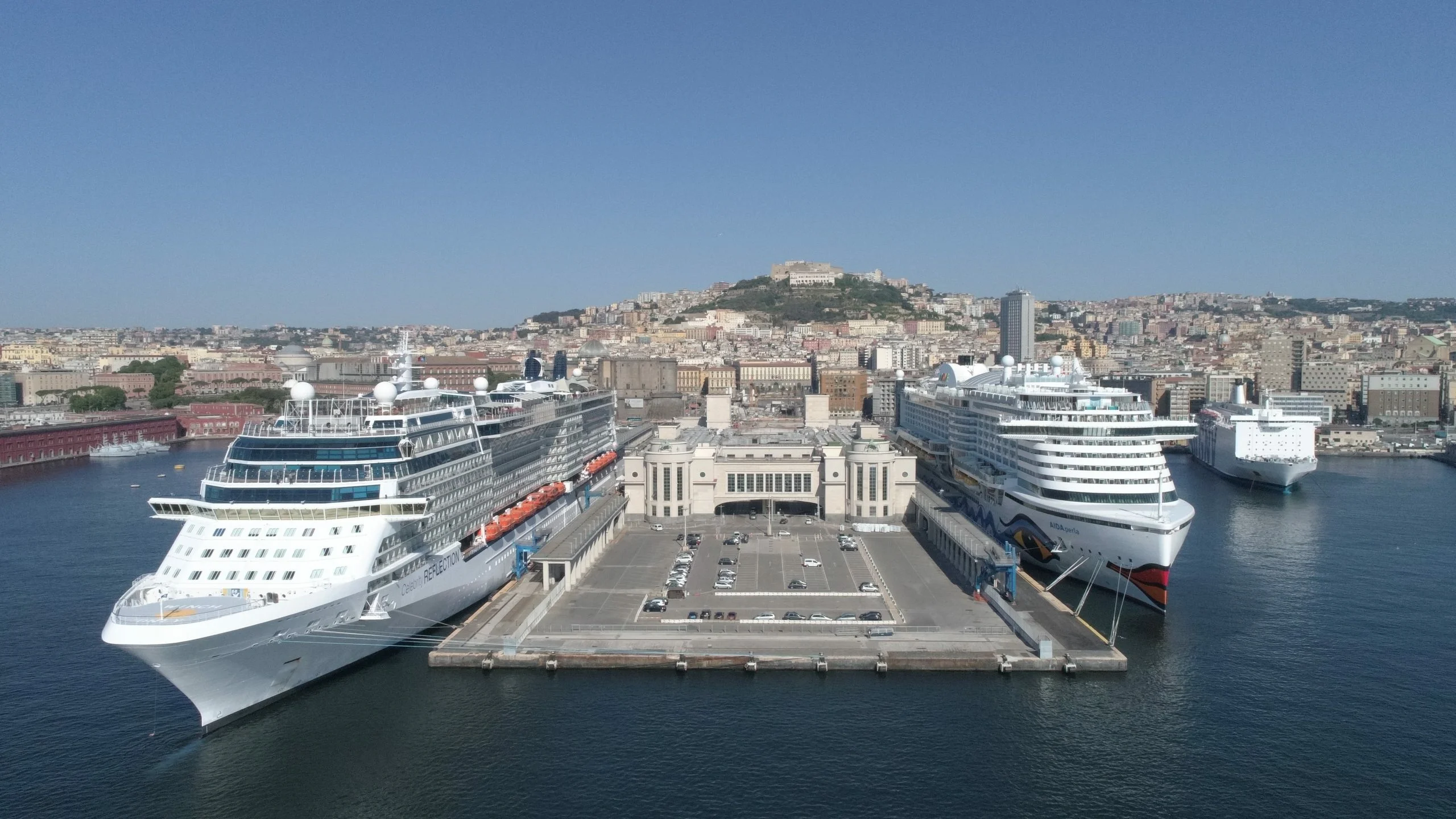
A cruise call in Naples gives you a window of a few hours and a single real decision: stay in the city, or leave the bay for Capri, Procida, or the Amalfi Coast and come back before the ship sails. The first option is straightforward. The second is the one that makes people hesitate, because it carries a fear that is entirely rational. Miss the return crossing, and the ship does not wait.
That fear is worth taking seriously, and it is also solvable. The problem is not the distance. It is the fact that scheduled ferries run on their timetable, not yours, and a cruise day leaves no room for a missed connection. This guide is about how to leave the port, see something beyond the city, and be back on board with margin to spare.
The one number that governs your whole day: all-aboard time
Every shore day is built around a single figure, and it is not the departure time printed on your itinerary. It is the all-aboard time, the moment by which every passenger must be back on the ship. It typically falls thirty to sixty minutes before the vessel actually sails, and it is not negotiable. The gangway closes, and anyone not on board is left to catch up with the ship at the next port, at their own expense.
Everything else follows from that number. Before you plan a single stop, find your all-aboard time on the daily program, then work backward. The question is never “how long does it take to reach Capri,” it is “what is the latest I can leave the island and still be at the gangway with a buffer.” Plan against the all-aboard time, not against the sailing time, and build in a margin for the unexpected.
The risk with independent excursions, and how to remove it
The reason cruise lines warn against independent excursions is real. If you book your own ferry to an island and that ferry is delayed, cancelled for weather, or simply full on the return, the ship has no obligation to wait for you. Scheduled services in the Bay of Naples are frequent in summer, but they are also crowded, weather-sensitive, and entirely outside your control. On a normal holiday a missed boat costs you an afternoon. On a cruise day it can cost you the ship.
A private boat removes that variable. The return is not a public departure you have to make, it is your own schedule, set around your all-aboard time and confirmed before you leave the dock. You are not standing in a queue hoping to fit onto the last hydrofoil with two hundred other people. The crossing is booked to bring you back with margin built in, which is the one thing a cruise passenger cannot improvise. Our private boat transfer service is built around exactly this kind of fixed-window day.
Capri in a port day: is it realistic?
Yes, with honest margins. Capri sits close enough to Naples that a half-day on the island is achievable within a normal cruise window, provided you treat the return as fixed and everything else as flexible. The mistake is trying to do the whole island. You will not see the Blue Grotto, ride the chairlift to Monte Solaro, walk to the Faraglioni, and shop in the piazzetta in a single port morning. Choose one or two of those and do them without rushing.
The realistic version is a morning crossing, a couple of unhurried hours ashore or on the water around the island, and a return with a clear buffer before all-aboard. Approached that way, Capri from a cruise ship is not a gamble. Approached as a race, it is.
The quieter alternative: Procida and the Phlegraean coast
If your window is shorter, or Capri in August sounds like more crowd than you want, the western side of the bay is the better answer. Procida is closer than Capri, far less visited, and its harbor at Marina Corricella is one of the most photographed corners of the region precisely because so few day visitors reach it. The Phlegraean coast between Naples and Procida adds volcanic scenery that most cruise passengers never see.
The advantage on a cruise day is time. A shorter crossing means more margin against your all-aboard time and less of the day spent in transit. It is the choice for travelers who would rather see one quiet place well than one famous place in a hurry.
What the ship’s own excursion does not give you
The cruise line’s organized excursion solves the timing problem in the simplest way: if the tour runs late, the ship waits, because it is the ship’s own tour. That guarantee is worth something, and it is fair to say so. If certainty is the only thing you care about, the official excursion delivers it.
What it does not deliver is control over the rest of the day. You move on a fixed group schedule, with a set route, a set pace, and a boat shared with everyone else who booked it. There is no detour for a swim in a bay that happens to be calm that morning, no lingering somewhere you like, no adjusting to how you actually feel once you are on the water. A private transfer keeps the timing discipline that a cruise day demands while giving back the flexibility and privacy that a group tour removes. The trade is certainty-with-rigidity against certainty-with-freedom, and for many travelers the second is worth arranging.
A realistic timeline for a day ashore
The exact hours depend on your ship’s schedule and the season, so treat this as a shape rather than a timetable. You disembark once the ship is cleared, usually not the moment it docks but shortly after. You meet your boat at the port and cross to the island, using the outbound leg as part of the experience rather than dead time. You have your window ashore or around the coast, deliberately shorter than the maximum the day would technically allow. Then you return with a deliberate buffer, arriving back well before all-aboard rather than exactly on it.
The principle behind the shape matters more than the hours. Every part of the day flexes except the return, and the return is set against the all-aboard time with margin, not against the sailing time. Build the day that way and it holds together even if one thing runs slightly long.
If you would rather stay in Naples
Leaving the bay is not the only good choice. Naples itself is one of the easiest cruise stops in the Mediterranean to enjoy on foot, with the historic center, the food, and the museums all within reach of the port. If that sounds more like your kind of day, our guide to spending a day in Naples from the cruise port covers what to see, where to eat, and how to make the most of a few hours in the city without leaving town. This article and that one cover the two halves of the same decision.
Frequently asked questions
Can I visit Capri on my own during a cruise stop in Naples?
Yes, as long as you treat your return as fixed and plan around your all-aboard time rather than the ship’s sailing time. A private boat transfer is the most reliable way to do it, because the return is set to your schedule with a margin built in, rather than depending on a crowded public ferry.
What happens if I miss the ship?
The ship sails at its scheduled time and does not wait for independent travelers who are late. You would be responsible for reaching the next port of call yourself. This is why the return crossing, not the outbound one, is the part of a cruise-day plan that has to be certain.
Is a private boat safer than a public ferry for a cruise day?
It is more reliable for the specific problem of a fixed return. Public ferries are frequent but crowded, weather-sensitive, and outside your control, and a delayed or full return service can put your all-aboard time at risk. A private transfer sets the return around your schedule instead.
How much of Capri can I realistically see in a port day?
One or two things done well, not the whole island. A morning crossing, a couple of unhurried hours ashore or around the coast, and a return with a clear buffer is realistic. Trying to fit in the Blue Grotto, Monte Solaro, and the Faraglioni in a single morning is not.
Is Procida a better choice than Capri for a short stop?
For a shorter window, often yes. Procida is closer to Naples, which means more margin against your all-aboard time and less of the day spent crossing, and it is far less crowded than Capri in high season.