


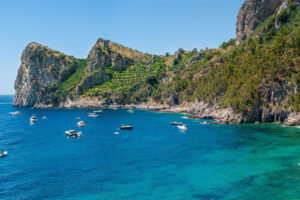
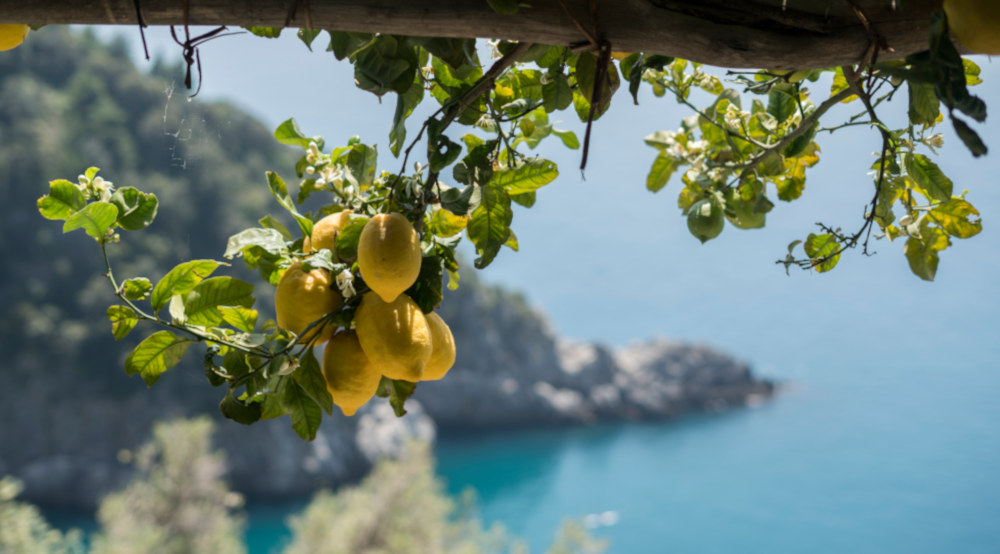
Few agricultural products are as closely tied to a place as the lemons of the Amalfi Coast. More than a local crop, they are part of the visual identity of the coastline itself: bright yellow fruit hanging over terraced slopes, stone walls facing the sea, and pergola-style groves built to adapt cultivation to a dramatic landscape. Along this stretch of Campania, lemons are not simply grown. They help define the territory. The best-known local variety is the Sfusato Amalfitano, the cultivar linked to the protected geographical indication Limone Costa d’Amalfi PGI, known for its elongated shape, aromatic peel, and strong fragrance.
Why Amalfi Coast lemons are different
When travelers think about Amalfi Coast lemons, they often imagine large, fragrant fruit sold in ceramic shops, displayed in gardens, or used in desserts and liqueurs. But their distinctiveness begins in agriculture, not merchandising. The traditional local lemon is the Sfusato Amalfitano, a variety associated with the production area recognized under the PGI designation. Its tapered form, thick aromatic peel, abundant juice, and intense scent make it one of the best-known lemon expressions in southern Italy.
This is not a generic Mediterranean lemon. It is the result of a specific environmental and human context. The steep slopes of the Amalfi Coast, the exposure to sunlight, the influence of the sea, and centuries of agricultural adaptation all contributed to shaping a fruit that became inseparable from the identity of the region. UNESCO describes the Amalfi Coast as a cultural landscape created by the combined work of nature and people, and lemon cultivation is one of the clearest examples of that relationship.
A landscape built around cultivation
One of the most striking aspects of the Amalfi Coast is that agriculture here is visible. Visitors do not need to enter a rural interior to understand how the land has been used. The cultivated landscape appears directly above roads, villages, and sea views, where terraces climb the hillsides in a system that reflects generations of labor and adaptation. Lemon groves are often supported by dry-stone walls and chestnut wood pergolas, practical solutions developed to make cultivation possible on difficult terrain and to protect the plants.
This is why the lemons of the Amalfi Coast should be understood not only as a product, but as part of the scenery. The yellow fruit, green leaves, handmade terraces, and blue sea form a single visual language. In places such as Minori and Maiori, the connection between farming and landscape is especially evident, and the famous Path of Lemons still preserves that relationship between daily work, local mobility, and hillside cultivation.
The Path of Lemons as a cultural symbol
The Path of Lemons is more than a scenic walk. It reflects how agricultural life shaped movement, trade, and local memory. Historically, these hillside paths connected communities and allowed the transport of lemons from the terraces down toward the coast. Today, the route is appreciated for its views and atmosphere, but it also reveals a deeper truth: on the Amalfi Coast, cultivation was never separate from everyday life. It was embedded in it.
The role of lemons in local identity
Local identity on the Amalfi Coast is built through a combination of geography, food culture, craftsmanship, and memory. Lemons sit at the center of all four. They appear in home gardens, in pastry traditions, in family-run farms, in local drinks, and in the imagery used to represent the coast to the world. Their presence is so strong that they function as a symbol of place even for travelers who know little about agriculture.
But reducing them to a postcard image would miss the point. Amalfi Coast lemons also represent continuity. They tell the story of a coast where communities learned to cultivate difficult land rather than abandon it. They reflect a local economy historically linked to small-scale farming and specialty production. In this sense, the lemon is not just a flavor of the Amalfi Coast. It is one of the clearest expressions of how the region has negotiated beauty, labor, and survival over time.
From cultivation to the table
The culinary role of Amalfi Coast lemons helps explain why they remain so present in local identity. Their peel and juice are used in desserts, salads, fish dishes, and drinks, while their aromatic intensity makes them particularly valued in preparations where fragrance matters as much as acidity. The same local lemon is also tied to the protected geographical indication for Liquore di Limone della Costa d’Amalfi, confirming how closely the fruit is linked to local gastronomic production.
This culinary versatility matters for tourism as well. Many visitors first encounter the lemon through food and drink, but that sensory experience often leads them back to the landscape itself. A lemon dessert in a coastal town, a tasting in a hillside farm, or a walk through the terraces all become part of a connected narrative. Food is not isolated from place; it is one of the ways the place is understood.
Why lemon cultivation still matters today
In many destinations, iconic products survive mostly as branding devices. On the Amalfi Coast, lemons still retain a more substantive role because they connect agriculture, heritage, and destination identity. They preserve traditional knowledge, sustain local storytelling, and help maintain the visual and cultural distinctiveness of the coast. Even for travelers who come primarily for the sea, villages, or views, lemon cultivation offers a way to understand the territory more deeply.
This matters especially for those seeking a more authentic experience of Campania. To notice the lemons of the Amalfi Coast is to notice the human work behind the landscape. The terraces are not ornamental. The groves are not decorative. They are evidence of a long relationship between people and terrain, and of a form of local identity still rooted in cultivation rather than detached from it.
Seeing the Amalfi Coast through its lemons
For travelers exploring this part of Italy, lemons offer a useful key to reading the coast. They explain why the slopes look the way they do. They clarify the connection between farming and architecture. They provide context for local cuisine. And they reveal how a product can become a symbol without losing its agricultural meaning.
That is why the lemons of the Amalfi Coast are more than a regional specialty. They are part of a wider cultural landscape shaped by cultivation, adaptation, and memory. To understand them is to understand something essential about the Amalfi Coast itself.
