
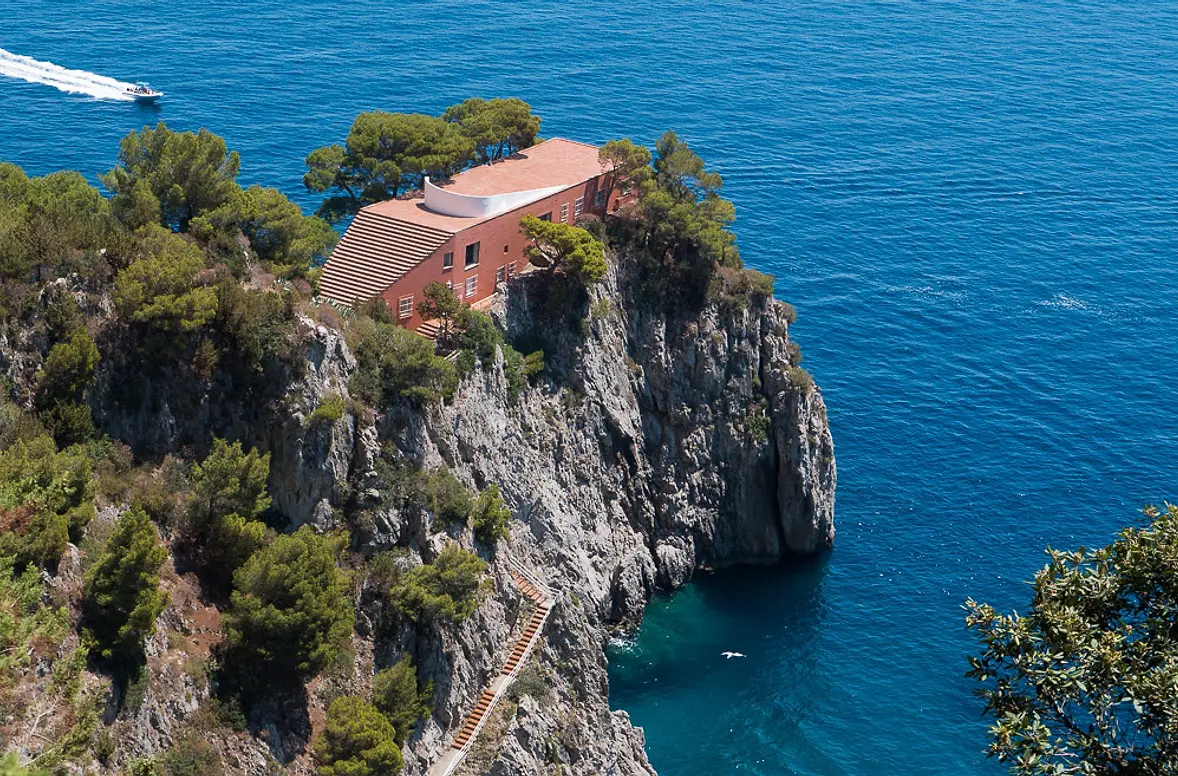
Few places in the Mediterranean blend literature, architecture, and landscape as powerfully as Capri. Among its cliffs and dramatic horizons stands one of the island’s most enigmatic landmarks: Casa Malaparte, the famous red house perched above the sea, visible almost exclusively from the water.
To understand its meaning, one must begin with its creator Curzio Malaparte, writer, intellectual, and controversial observer of 20th-century Italy.
Curzio Malaparte and La Pelle
Curzio Malaparte was a complex and provocative figure, known for his sharp gaze on history and human nature. His novel La Pelle (The Skin), set in Naples during the final years of World War II, offers a raw and unsettling portrait of a city caught between defeat, survival, and dignity.
Through vivid scenes and brutal honesty, Malaparte describes Naples not as a postcard, but as a living body marked by history, contradictions, and resilience. The sea, the port, and the relationship between land and water play a central role in the narrative reinforcing Naples as a city born from the Mediterranean.
Casa Malaparte: A House Against the Cliff
Built in the 1930s on the eastern cliffs of Capri, Casa Malaparte is one of the most striking examples of modern Italian architecture. Its bold red color, geometric form, and monumental staircase rising toward the sky make it appear both isolated and defiant.
The house was designed as a personal retreat, a place of solitude and reflection. Perched high above the rocks, it stands deliberately distant from the island’s social life, accessible only by footpaths or, more memorably, visible from the sea.
This unique positioning transforms Casa Malaparte into a silent presence along the coastline, revealing itself slowly to those navigating the waters around Capri.
Why the House Is Best Seen from the Sea
From land, Casa Malaparte remains elusive, partially hidden and difficult to reach. From the sea, however, it reveals its full character. Sailing along Capri’s eastern coast, the red structure emerges against the limestone cliffs, suspended between sky and water.
This perspective explains why the house has become an icon for filmmakers, photographers, and travelers. It was famously featured in Jean-Luc Godard’s Le Mépris, reinforcing its cinematic aura and its connection to the sea as a narrative space.
Seeing Casa Malaparte from a boat tour around Capri allows visitors to grasp its intention: not a villa meant to be entered, but a symbol meant to be observed solitary, radical, and inseparable from the landscape.
Literature, Architecture, and the Sea
Malaparte’s work and his house share the same philosophy: confronting reality without mediation. Just as La Pelle strips away illusions about post-war Naples, Casa Malaparte refuses decorative comfort, standing instead as a dialogue between man, stone, and sea.
For travelers exploring Capri by boat, this encounter becomes more than a sightseeing moment. It is a cultural experience, where literature, architecture, and nature converge visible only when approaching the island from the water.
Experiencing Capri Beyond the Surface
A private boat tour around Capri reveals layers of the island that often remain unseen from land. Beyond famous caves and rock formations, the coastline tells stories of artists, writers, and thinkers who found inspiration in isolation and sea horizons.
Casa Malaparte remains one of the most powerful examples of this connection, a place that belongs as much to the Mediterranean as to the imagination.
