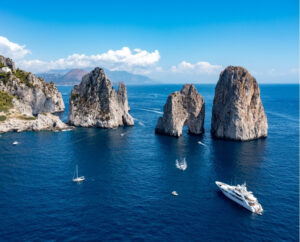
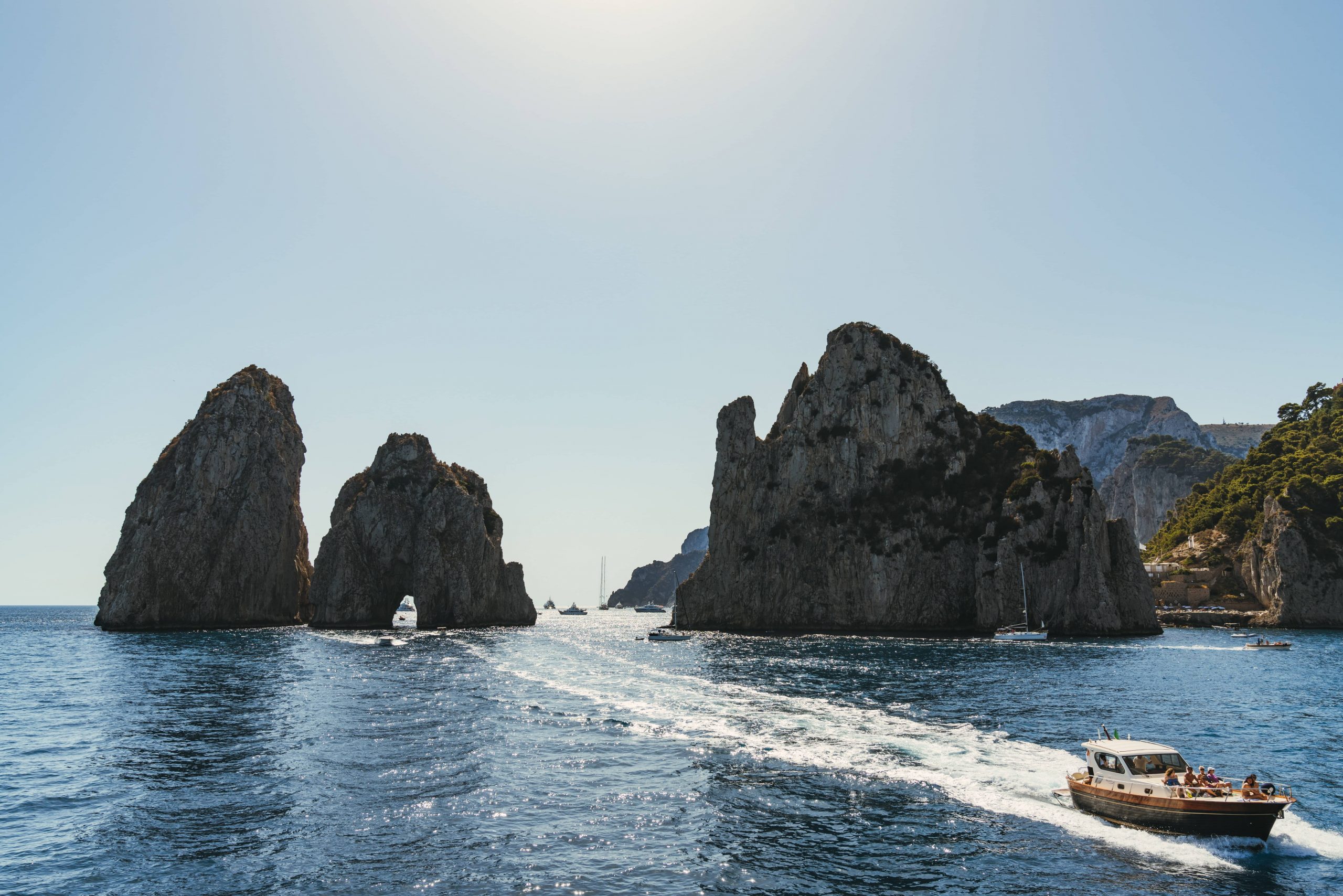
The Faraglioni of Capri are among the most photographed sea stacks in the Mediterranean, yet very few travelers truly understand what they are, how they were formed, and why their appearance changes so dramatically when seen from the water.
From land, they are iconic silhouettes. From the sea, they become something else entirely: a geological story, a navigational landmark, and a living symbol of Capri’s relationship with the sea.
Understanding the Faraglioni from a maritime perspective reveals why a boat experience around Capri offers a radically different level of insight compared to viewpoints on the island.
What the Faraglioni of Capri actually are
Geologically, the Faraglioni are limestone sea stacks, remnants of an ancient coastal cliff that once extended far beyond Capri’s current shoreline.
Over thousands of years, wind, salt, and wave erosion gradually carved away the softer rock, leaving behind these massive vertical formations isolated from the island.
They are composed primarily of calcareous rock, typical of the Sorrento Peninsula and Capri itself, shaped by tectonic uplift and continuous marine erosion.
The three Faraglioni have distinct identities:
-
Faraglione di Terra, the closest to the island and still connected to Capri’s rocky slope.
-
Faraglione di Mezzo, recognizable by the natural arch carved by the sea.
-
Faraglione di Fuori (Scopolo), the most distant and exposed to open water.
Seen from the sea, their scale becomes immediately apparent. From land, perspective flattens their dimensions; from a boat, their verticality and mass dominate the horizon.
Why the Faraglioni look different from the sea
Most visitors first encounter the Faraglioni from panoramic terraces such as the Gardens of Augustus. These viewpoints frame them as static landmarks.
From the sea, however, several factors completely change their appearance.
Perspective and scale
From a boat, the eye aligns with the base of the rock formations rather than their tops. This reveals:
-
the sheer height of the limestone walls,
-
the undercut shapes sculpted by wave action,
-
the contrast between submerged rock and exposed surfaces.
The Faraglioni feel taller, more imposing, and far more dynamic when approached at water level.
Light and reflection
Light behaves differently at sea. The white limestone reflects sunlight directly onto the water, while the surrounding depths absorb and refract it.
Depending on the time of day, the Faraglioni may appear:
-
pale and luminous in the morning,
-
warm and golden in the afternoon,
-
dramatically shadowed as the sun lowers toward the horizon.
This constant interaction between rock, sun, and sea is only perceptible from the water.
Water color and seabed depth
The sea around the Faraglioni changes color abruptly due to variations in seabed depth and rock composition.
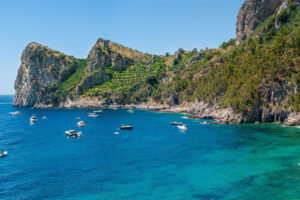
Near the stacks, deep blue tones dominate, interrupted by flashes of turquoise where submerged limestone reflects sunlight upward.
This chromatic contrast is one of the reasons the Faraglioni are so visually striking from a boat and comparatively flat from land-based viewpoints.
The legends surrounding the Faraglioni
Like much of Capri, the Faraglioni are surrounded by layers of myth and legend rooted in ancient Mediterranean culture.
According to local tradition, the rocks were once part of the territory haunted by sirens, whose songs attempted to lure sailors toward the cliffs.
In Roman times, the Faraglioni were considered symbolic guardians of the island, marking the threshold between protected coastal waters and the open Tyrrhenian Sea.
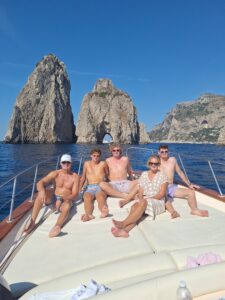
The arch of Faraglione di Mezzo, today a passage for boats, has long been associated with good fortune and fertility. Passing beneath it was believed to ensure safe voyages and favorable winds.
These legends are not merely folklore; they reflect the historical importance of the Faraglioni as maritime reference points long before Capri became a leisure destination.
Why the Faraglioni are a navigational landmark
For centuries, sailors approaching Capri identified the island first by the silhouette of the Faraglioni rising from the sea.
Their visibility from afar made them natural markers for navigation, signaling proximity to the island even before Capri itself was clearly distinguishable.
From the water, their alignment also reveals how Capri’s coastline curves and protects certain bays from dominant winds.
This explains why boat-based exploration provides a deeper understanding of the island’s geography and natural defenses.
Experiencing the Faraglioni by boat
Approaching the Faraglioni by sea is not simply a scenic moment; it is a way to read Capri’s geological and historical identity.
A boat allows you to:
-
observe erosion patterns at the base of the rocks,
-
experience the acoustic change as waves echo between the stacks,
-
perceive the transition from coastal shelter to open sea.
These details are invisible from land but define the Faraglioni as living structures shaped by constant interaction with the Mediterranean.
The Faraglioni as part of Capri’s coastal narrative
The Faraglioni are not isolated monuments. They are part of a broader coastal system that includes caves, cliffs, and hidden inlets accessible only from the sea.
Understanding them in this context transforms them from a postcard image into a key chapter of Capri’s natural history.
For travelers planning a visit, this perspective reinforces a simple truth: Capri reveals its most authentic character when observed from the water, where geology, legend, and landscape converge.